


Religious Cairo is not just a collection of sacred monuments. It is the story of how ancient Egyptian beliefs, Christian traditions and Islamic civilization shaped the identity, architecture and daily life of Egypt’s capital across thousands of years.
Quick Answer: What makes Religious Cairo special?
Cairo is one of the few cities where travelers can explore three major layers of spiritual history in one journey: the Pharaonic sacred landscape of Giza, the early Christian heritage of Old Coptic Cairo and the mosques, madrasas and minarets of Islamic Cairo.
Religious Cairo: A Living Museum of Faith and Culture
Cairo is one of the few cities in the world where the history of three great civilizations — Pharaonic, Christian and Islamic — can be explored across one urban landscape. Known by many travelers as a living museum of faith and culture, Religious Cairo offers a rare opportunity to understand how sacred beliefs and architectural masterpieces evolved side by side.
Exploring the spiritual heritage of Cairo is not simply about checking monuments off a list. It is about tracing how religion shaped power, identity, art, education, community life and the visual character of Egypt’s capital.
That is why a carefully planned Cairo Day Tour can be more powerful than ordinary sightseeing. With the right route, travelers can move from the sacred geometry of Giza to the churches of Old Cairo and the mosque architecture of medieval Cairo in one meaningful day.
Travel Truth
The mistake many visitors make is treating the Pyramids, Coptic Cairo and Islamic Cairo as separate attractions. The stronger experience is to read them as three connected chapters in Cairo’s long spiritual history.
Ancient Egyptian Beliefs and the Sacred Landscape of Giza
The roots of Religious Cairo begin long before the medieval city itself was founded. In ancient Egypt, religion was inseparable from life, death, kingship and the afterlife. The Pyramids of Giza stand as the ultimate expression of ancient Egyptian spiritual beliefs, reflecting a civilization deeply concerned with eternity, divine order and the journey of the soul.
The Great Pyramid, the Great Sphinx and the surrounding necropolis were not merely royal monuments. They formed a sacred landscape connected with solar symbolism, royal transformation and the ancient Egyptian belief that the king could join the divine realm after death.
For travelers, the Giza Plateau is the essential starting point for understanding how religion shaped Egypt long before Christianity and Islam arrived. A private Cairo Day Tours route can connect the Pyramids with later religious landmarks to show the full timeline of Cairo’s sacred heritage.
Divine Kingship
The pharaoh was not only a ruler, but a sacred figure connected with cosmic order and the gods.
Solar Symbolism
Giza’s monuments reflect ideas of light, eternity, rebirth and the king’s journey beyond earthly life.
Sacred Necropolis
The plateau was designed as more than a cemetery; it was a ritual landscape for royal afterlife belief.
Old Coptic Cairo: The Rise of Christianity in Egypt
With the spread of Christianity in Egypt during the first centuries AD, a new spiritual chapter began. Old Coptic Cairo became one of the most important centers of Christian worship and identity in the Middle East.
This historic district is home to some of Egypt’s most meaningful churches, many of them built near or within the area of the old Roman fortress of Babylon. The Hanging Church, raised above a Roman gate, symbolizes the endurance of Egypt’s Christian community through centuries of political and cultural change.
Nearby, Abu Serga Church, often called the Cavern Church, is traditionally associated with the Holy Family’s journey through Egypt. Whether approached through faith, history or architecture, Coptic Cairo preserves a deeply spiritual atmosphere that remains alive today.
| Coptic Cairo site | Why it matters | Best visitor focus |
|---|---|---|
| Hanging Church | One of Cairo’s most iconic Coptic churches, built above a Roman fortress gate. | Architecture, icons, Coptic identity and early Christian heritage. |
| Abu Serga Church | Traditionally linked with the Holy Family’s stay in Egypt. | Holy Family tradition, pilgrimage meaning and sacred atmosphere. |
| Roman Fortress Area | Shows how Christian Cairo developed within older Roman urban layers. | Urban history, defensive architecture and religious continuity. |
| Coptic Museum Area | Connects Coptic art, manuscripts, textiles, woodwork and religious symbolism. | Art history, Christian Egypt and cultural transition. |
Islamic Cairo: A Golden Age of Faith and Architecture
The arrival of Islam in the 7th century transformed Egypt’s religious and cultural landscape. Over time, Cairo grew into one of the most important cities of the Islamic world, filled with mosques, madrasas, minarets, gates, markets and charitable institutions.
Islamic Cairo is not one single monument. It is an entire historic environment where architecture reflects different dynasties, styles and spiritual priorities. Mosques were places of prayer, learning, community organization and urban identity.
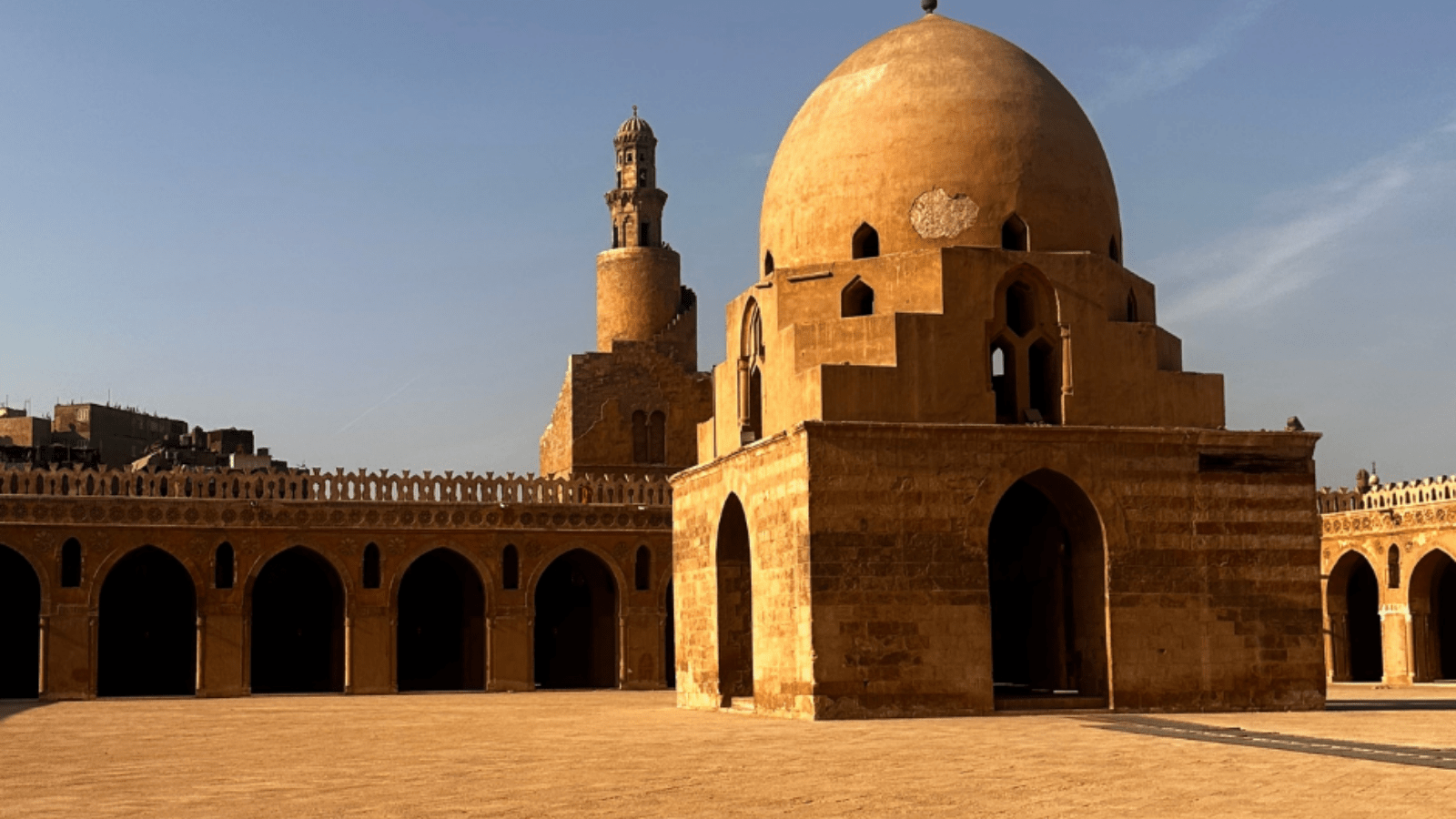
One of the most significant monuments of this era is the Ibn Tulun Mosque, one of Cairo’s oldest surviving mosques. Its vast courtyard, calm geometry and famous spiral minaret make it one of the best places to understand early Islamic architectural philosophy.
Ibn Tulun Mosque
Best for understanding early Islamic architecture, open courtyards, simplicity and spiritual scale.
Sultan Hassan Mosque
A masterpiece of Mamluk architecture, religious education and monumental urban design.
Al-Rifa’i Mosque
Important for royal burials, historic memory and its relationship with Sultan Hassan Square.
Historic Islamic Streets
Markets, gates, minarets and madrasas reveal how faith shaped daily urban life.
Best Religious Cairo Itinerary: Pyramids, Churches and Mosques in One Day
The strongest way to experience Religious Cairo is to follow the city’s spiritual timeline. Start with the Pharaonic sacred landscape at Giza, continue into Old Coptic Cairo, then end among the mosques and historic streets of Islamic Cairo.
A route such as a Pyramids, Churches and Mosques Cairo Day Tour helps travelers understand Cairo as a crossroads of civilizations rather than a collection of disconnected monuments. This is especially valuable for culture lovers, first-time visitors, family travelers and anyone interested in faith, architecture and history.
| Route stage | Suggested focus | Why it works |
|---|---|---|
| Morning: Giza Plateau | Pyramids, Great Sphinx and ancient afterlife beliefs. | Shows the earliest religious layer of the Cairo region. |
| Midday: Old Coptic Cairo | Hanging Church, Abu Serga Church and Coptic heritage. | Connects Christian Egypt with Roman and early medieval layers. |
| Afternoon: Islamic Cairo | Ibn Tulun, Sultan Hassan, Al-Rifa’i or selected historic mosques. | Shows Cairo’s role as a major Islamic cultural and architectural capital. |
| Optional add-on | Historic markets, panoramic viewpoints or museum context. | Adds atmosphere, local life and stronger storytelling. |
CRO Note for Travelers
This route is best done privately, not rushed in a large group. The value comes from interpretation: why each site mattered, how beliefs changed and how Cairo absorbed every layer into one living city.
Best Cairo Tours for Religious and Cultural Heritage
Choose your Cairo experience based on how deep you want to go. Some travelers want the full religious timeline in one day, while others prefer a broader Cairo sightseeing route with museums, bazaars and classic landmarks.
Cairo Day Tours
Explore Giza, Old Cairo, Islamic Cairo, museums, bazaars and private cultural routes.
View Cairo tours → Custom routeTailor-Made Religious Cairo Tour
Create a private itinerary around Pharaonic, Christian and Islamic landmarks.
Plan your route → Multi-day EgyptEgypt Tour Packages
Combine Cairo’s religious heritage with Luxor, Aswan, Nile cruises and ancient temples.
Explore packages → Private day tripPyramids, Churches and Mosques Cairo Day Tour
The most natural route for travelers who want Cairo’s three sacred layers in one day.
Start with Cairo Day Tours →Religious Cairo Today: A Living Cultural Experience
What makes Religious Cairo truly unique is not only its history, but its continuity. Unlike many ancient cities, Cairo’s religious landmarks are not frozen in time. Churches and mosques remain active places of worship, while historic neighborhoods continue to hold cultural meaning for local communities.
Modern visitors can experience this coexistence by exploring ancient monuments, churches and mosques in one seamless journey. The best tours do not reduce these places to architecture only; they explain how faith shaped identity, art, law, education, public space and family life.
This is why private Cairo Day Tours are especially useful for Religious Cairo. They allow travelers to move at the right pace, ask questions and connect the city’s layers without losing the human story behind each monument.
Why Religious Cairo Matters to Global History
Religious Cairo is more than a local heritage route. It reflects humanity’s shared spiritual journey: ancient beliefs in eternity, the growth of Christianity in Egypt and the rise of Islamic civilization in one of the most influential cities of the Mediterranean and Middle Eastern worlds.
For history lovers, cultural explorers and thoughtful travelers, Religious Cairo gives context to Egypt’s past and to the wider story of faith, architecture and cultural dialogue. Few places allow visitors to walk through so many spiritual eras in one city.
Architecture
Pyramids, churches, mosques and minarets show how sacred ideas became physical spaces.
Continuity
Cairo preserves layers of belief rather than replacing one historical identity with another.
Global Meaning
The city connects African, Mediterranean, Middle Eastern and world religious history.
Explore More on Egypt Tours Club
Continue your journey through Cairo’s sacred history, ancient monuments and cultural day tours.