


History of Alexandria’s Catacombs: Secrets Beneath the City
Descend beneath Alexandria to discover a second-century burial world where Egyptian belief, Greek art and Roman architecture meet.
Dating mainly to the second century CE, the Catacombs of Kom El Shoqafa preserve the multicultural character of Roman Alexandria in chambers carved deep into bedrock.
History and discovery
Local tradition says the entrance was revealed in 1900 after a donkey fell through an opening, leading archaeologists to the lost necropolis.
The earliest core was probably created for a wealthy family before the burial complex expanded across generations.
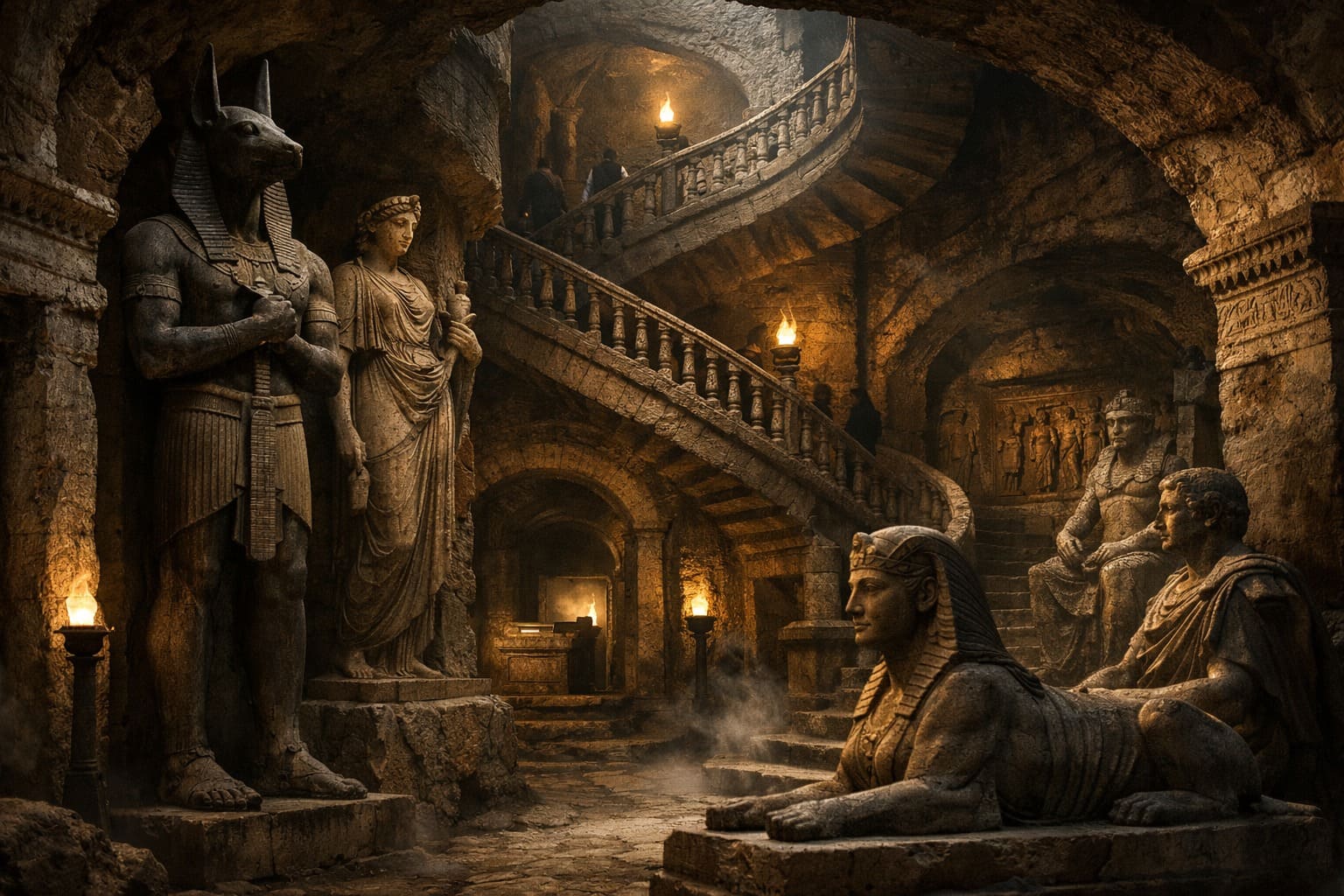
Egyptian funerary beliefs, Greek artistic taste and Roman architectural forms coexist throughout the monument.
Multiple underground levels, chambers, niches and corridors reveal a complex burial tradition beneath the modern city.
What to notice underground
Spiral staircase
The circular descent likely helped lower bodies and creates the dramatic transition into the necropolis.
Main burial chamber
Rock-cut sarcophagi, statues and symbolic reliefs form the visual heart of the complex.
Funerary banquet hall
Families gathered in the triclinium for memorial meals honoring the dead.
Hall of Caracalla
This intriguing section is traditionally associated with victims of violence during the Roman period.
Art, meaning and visitor planning
Figures combine Egyptian gods and bodies with Roman clothing, hairstyles and classical proportions.
Images of Anubis and funerary symbols express protection, rebirth and the journey after death.
Plan roughly 45–75 minutes rather than rushing the chambers in a short stop.
Morning fits Alexandria day tours well; the underground temperature can be cooler than outside.
Pair the catacombs with Pompey’s Pillar and the Serapeum before continuing toward the Library and Qaitbay.
Frequently asked questions
When were the catacombs discovered?
They were discovered accidentally in 1900, according to the traditional account.
How old are the Catacombs of Kom El Shoqafa?
Their main development dates to the second century CE during Roman rule in Egypt.
Why are the catacombs unique?
They combine Egyptian religious symbolism, Greek aesthetics and Roman burial architecture.
How long should visitors spend inside?
About 45–75 minutes allows a focused visit with time to understand the main chambers.
Are they suitable for everyone?
The stairs, narrow passages and dim lighting may be difficult for visitors with mobility limitations or claustrophobia.
Explore Alexandria beneath the surface
Add Kom El Shoqafa to a private Alexandria route with expert interpretation and well-planned nearby stops.
Plan My Catacombs Tour