


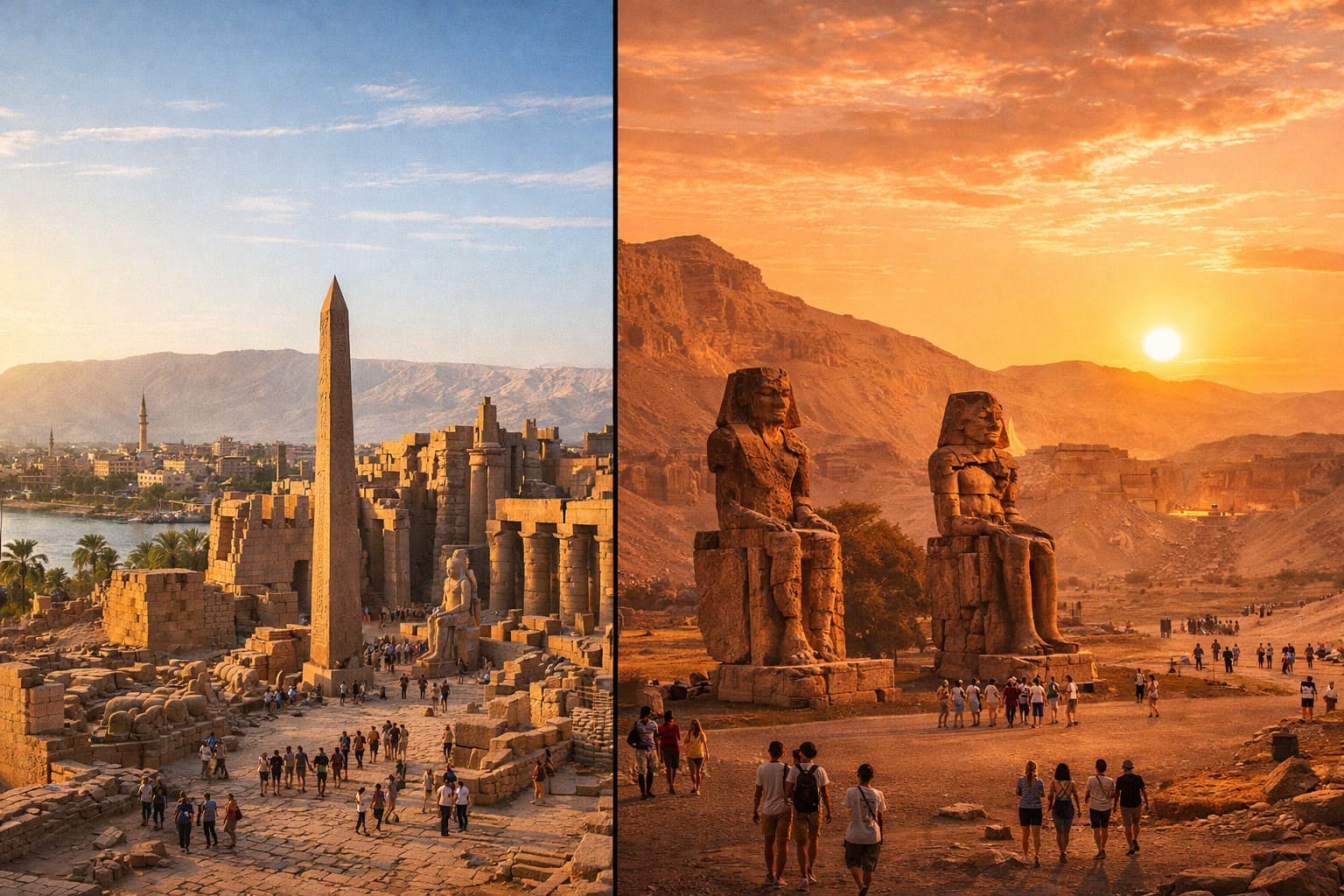
Luxor East Bank vs West Bank: What’s the Difference?
Understand the difference between Luxor’s temple-filled East Bank and the West Bank’s tombs, mortuary temples and desert necropolises.
East Bank: temples and city lifeWest Bank: tombs and desertBest first visit: bothLuxor is divided by the Nile into two distinct travel experiences. The East Bank is the living side of the city, while the West Bank is the ancient necropolis side.
Luxor East Bank: temples, museums and city life
The East Bank is the living side of Luxor. It contains hotels, restaurants, markets, Nile-side walks and two major temples: Karnak Temple and Luxor Temple. Many attractions are close to the city center, making this side easier to navigate.
The strongest anchor of an East Bank visit, known for the Great Hypostyle Hall, obelisks, pylons, sacred lake and long temple history.
Close to the city and especially atmospheric when illuminated in the evening.
An indoor stop for context, artifacts and relief from heat between outdoor temple visits.
Restaurants, markets, short taxi rides, Nile views and easy evening movement.
Hotels, museums, shops and transport are easier to access.
Temple lovers, short stays, cruise guests, families and evening visitors.
Luxor West Bank: tombs, mortuary temples and desert landscapes
The West Bank is Luxor’s ancient necropolis. It feels quieter, wider and more dramatic, with desert cliffs, royal tombs, mortuary temples and sites connected with ancient beliefs about death and rebirth.
The royal burial ground of New Kingdom pharaohs and the main reason many travelers visit the West Bank.
A dramatic terraced temple at Deir el-Bahari near the royal tombs.
A quick but iconic stop with two massive seated statues.
An excellent addition for deeper West Bank history.
A major mortuary temple for travelers going beyond the standard route.
Adds further context to the tomb-building community and the necropolis landscape.
Why East Bank means life and West Bank means afterlife
Ancient Egyptians associated the east with sunrise, renewal and daily life. The west, where the sun sets, was linked with death, burial and the journey into the afterlife. This explains why major temples and city life developed on the East Bank, while tombs and mortuary temples dominate the West Bank.
Luxor East Bank vs West Bank comparison
| Comparison point | Luxor East Bank | Luxor West Bank |
|---|---|---|
| Main theme | Temples, city life, museums and evening atmosphere. | Tombs, necropolises, mortuary temples and desert landscapes. |
| Top attractions | Karnak Temple, Luxor Temple, Avenue of Sphinxes and Luxor Museum. | Valley of the Kings, Hatshepsut Temple, Valley of the Queens, Medinet Habu and Colossi of Memnon. |
| Best for | Temple lovers, short stays, evening visits and city convenience. | History lovers, tomb art, photography, desert scenery and deeper Egyptology. |
| Best time | Early morning, late afternoon or evening for Luxor Temple. | Early morning before heat and crowds. |
| Walking and heat | Usually easier and more flexible. | More exposed and hotter, especially around tomb areas. |
| Ideal tour | Half-day East Bank tour or evening temple visit. | West Bank tomb and temple tour with an early start. |
Suggested Luxor routes
Karnak Temple and Luxor Temple when time is limited before a train, flight or Nile cruise.
Valley of the Kings, Hatshepsut Temple and Colossi of Memnon with an early start.
Start with the West Bank, cross the Nile, then visit Karnak and Luxor Temple.
Day one for West Bank tombs and mortuary temples; day two for East Bank temples, museums and slower city exploration.
West Bank early, Karnak late afternoon and Luxor Temple at night.
Add Valley of the Queens, Deir el-Medina, Medinet Habu, Dendera or Abydos.
How to move between both banks
| Transport option | Best for | Planning note |
|---|---|---|
| Private vehicle | Comfort, air-conditioning, early starts, families and full-day routes. | Best when combining many stops or traveling in hot months. |
| Local ferry | Independent travelers who want a simple Nile crossing. | Works better when West Bank transport is already planned. |
| Taxi | Flexible short movements between hotels, ferry points and attractions. | Agree clearly on price and route before starting. |
| Guided Luxor day tour | Transport, timing, guide, route logic and fewer mistakes. | Useful for travelers who want a complete organized route. |
Best time to visit each bank
| Timing | East Bank | West Bank |
|---|---|---|
| Early morning | Good for Karnak before heat and crowds. | Best for Valley of the Kings and exposed desert sites. |
| Midday | Use museums, lunch or a hotel break if hot. | Avoid in summer when possible because the area is exposed. |
| Late afternoon | Excellent for Karnak or Nile-side walking. | Can work for selected temple stops, but tomb access may be limited. |
| Evening | Best for Luxor Temple and city atmosphere. | Most tomb routes are not evening experiences. |
FAQs about Luxor East Bank vs West Bank
What is the difference between Luxor East Bank and West Bank?
The East Bank is known for Karnak, Luxor Temple, museums, hotels, restaurants and city life. The West Bank is known for royal tombs, mortuary temples, desert scenery and ancient necropolises.
Which is better, East Bank or West Bank?
Neither is better overall. The East Bank is stronger for temples and city convenience, while the West Bank is stronger for tombs, desert scenery and afterlife history.
Can I visit both banks in one day?
Yes, with an early start and a clear route. Two days is more relaxed.
What should I visit first?
Start with the West Bank early before heat and crowds, then return to the East Bank later.
Is the East Bank good at night?
Yes. Luxor Temple is especially beautiful when illuminated, and the East Bank has more evening city life.
Should I book a guide?
A guide is strongly useful because the temples and tombs contain religious scenes, royal symbolism, hieroglyphs and route decisions that are easy to miss without explanation.
Choose the right side, then plan the right route
Compare East Bank temples and West Bank tombs, then build a private Luxor route with clear timing and transport.
Explore Luxor day toursPlan a tailor-made route