

Temple of Hathor at Dendera: The Complete Guide to Egypt’s Best Preserved Temple
✨ Overview
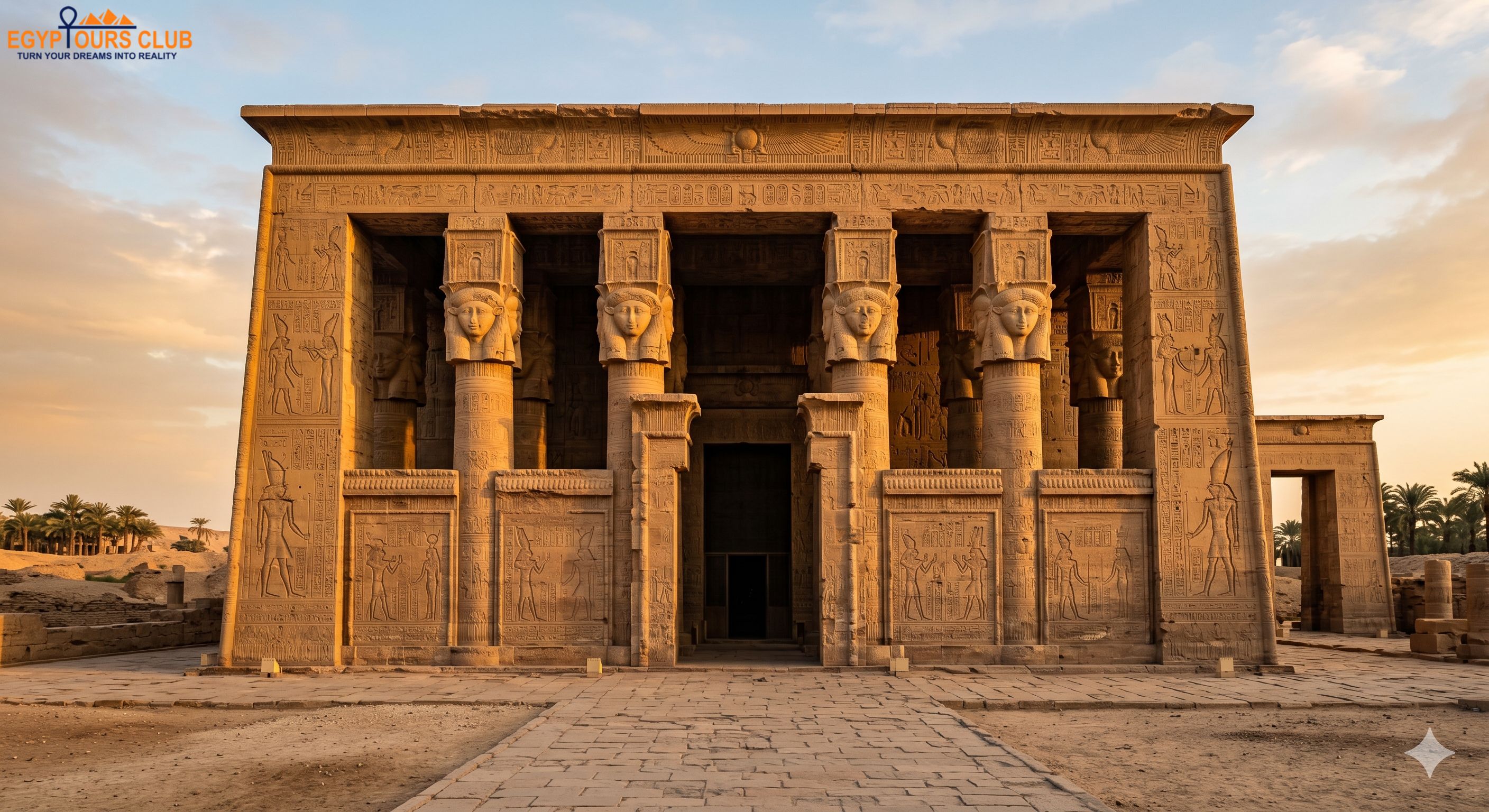
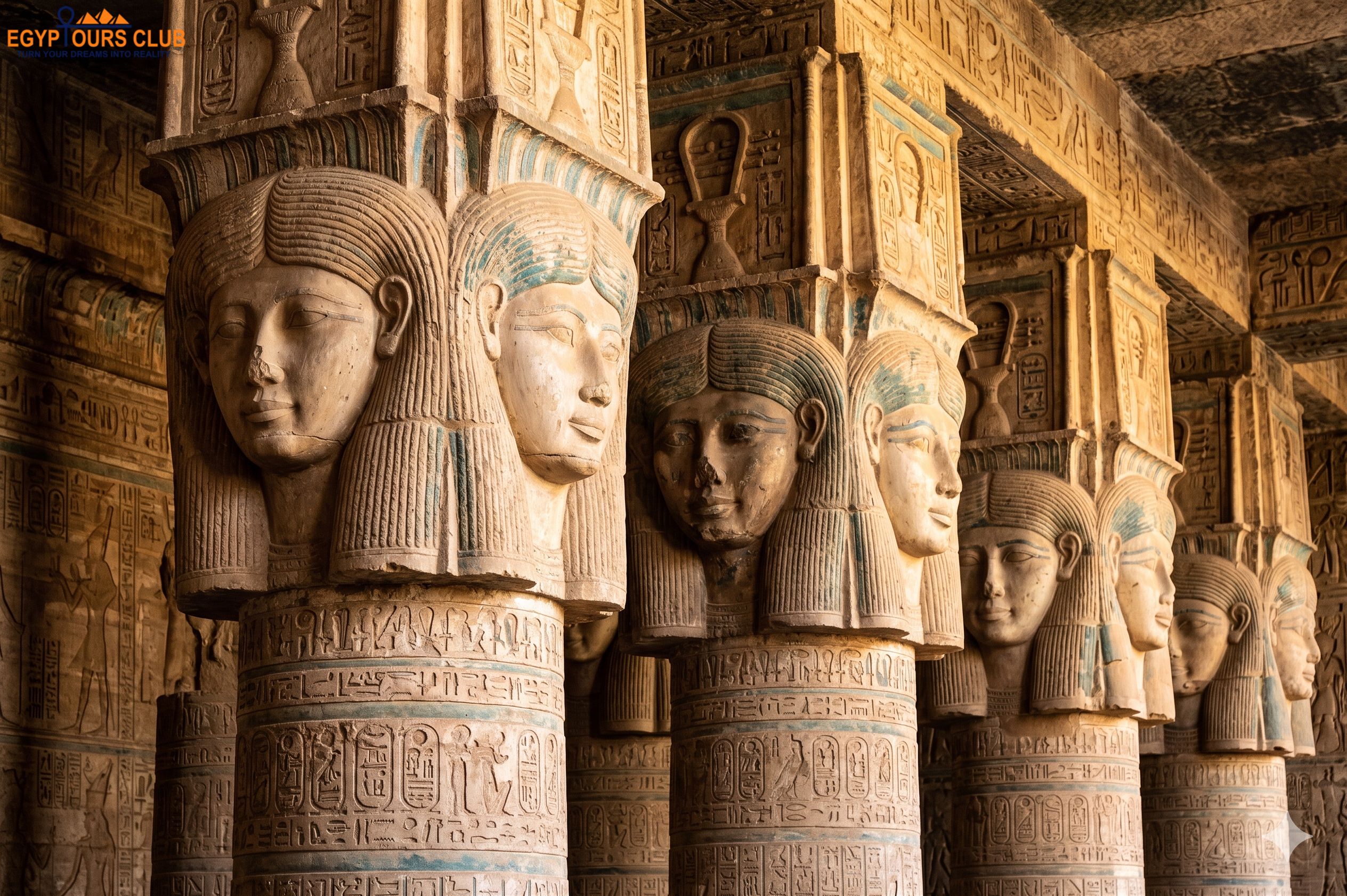
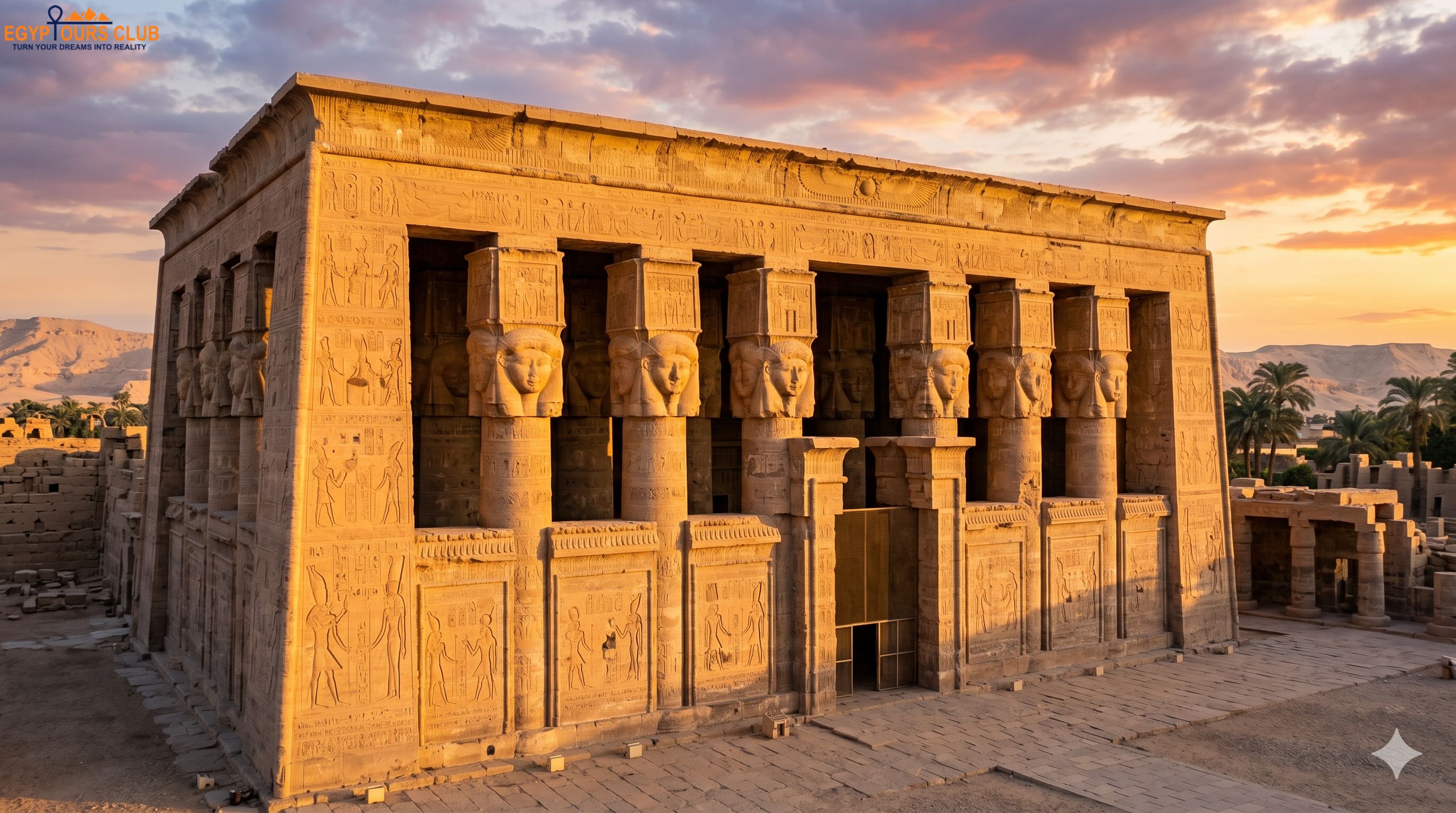
The Temple of Hathor at Dendera is one of the most remarkable sacred monuments in Egypt and one of the finest surviving examples of ancient temple architecture anywhere in the world. Located within the Dendera Temple Complex in Qena, north of Luxor, this extraordinary sanctuary is widely regarded as one of the best preserved temples in Egypt. Egypt’s official monuments platform describes the temple as one of the best-preserved in the country and highlights its magnificent entrance with six massive Hathor-headed columns among the most beautiful monuments in Egypt.
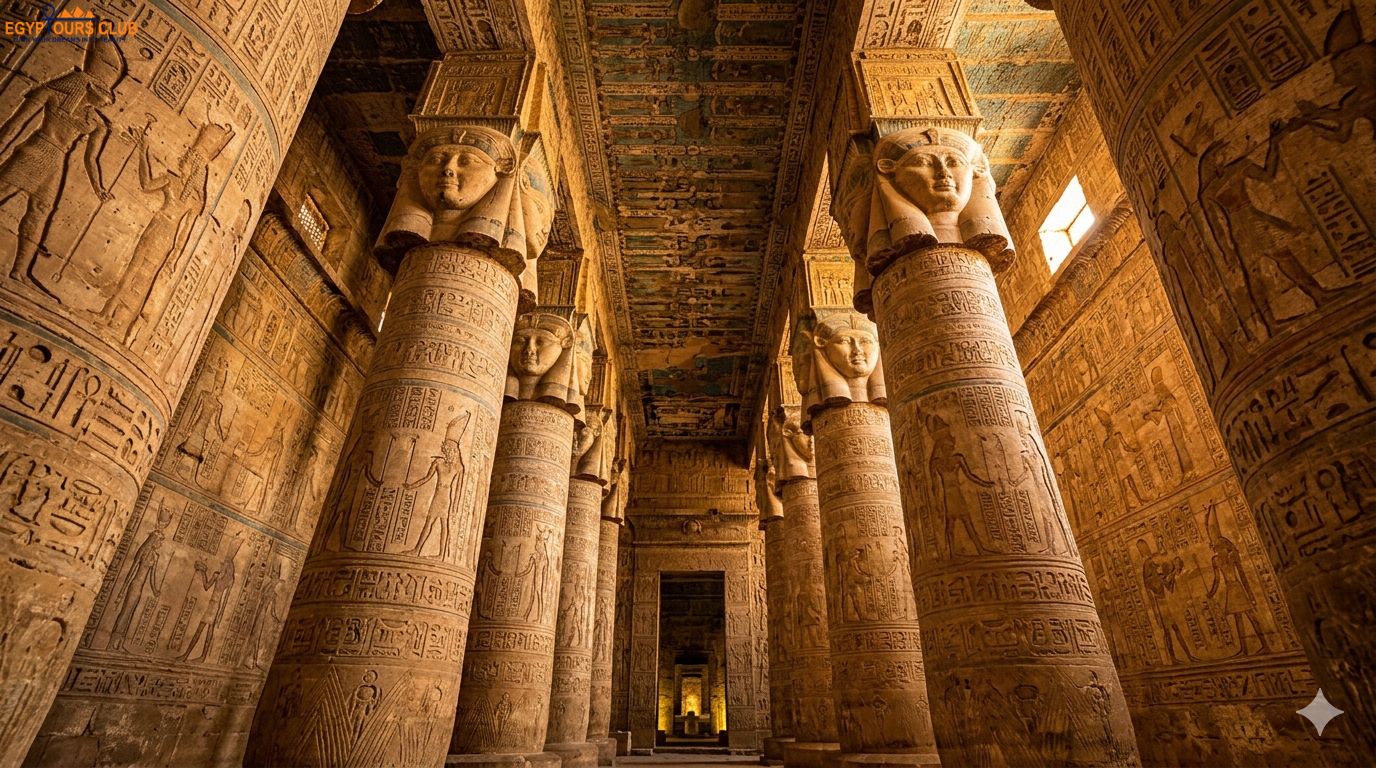
For travelers, historians, photographers, and lovers of ancient religion, the Temple of Hathor Dendera offers something unique: not just monumental architecture, but also vivid symbolism, celestial imagery, roof chapels, crypts, reliefs, and one of the most famous decorated ceilings in ancient Egypt. The temple is especially celebrated for the Dendera zodiac, the Dendera Temple ceiling, and the artistic richness of its halls and sanctuaries. Britannica notes the elaborately decorated hypostyle hall supported by 18 Hathor-headed columns and the ceiling carved with astronomical scenes.
Whether someone is searching what is the Temple of Hathor at Dendera, researching the history of the Temple of Hathor at Dendera, or planning a Dendera Temple day tour, this site stands out as one of the strongest cultural destinations in Upper Egypt. UNESCO states that the temple was begun under the Ptolemies and completed under the Roman emperor Tiberius, underlining both its long construction history and its major religious importance.
🏛️ What Is the Temple of Hathor at Dendera?
The Temple of Hathor at Dendera is the principal monument inside the Dendera Temple Complex, a large sacred enclosure dedicated mainly to Hathor, one of the most beloved goddesses in ancient Egyptian religion. Hathor was associated with music, joy, dance, motherhood, beauty, and the sky, and Dendera was her principal cult center. Egypt’s official monuments site explicitly identifies Hathor as one of ancient Egypt’s most important and popular deities and names Dendera as her main cult center.
If someone asks, what is the Temple of Hathor at Dendera, the clearest answer is this:
It is the main sanctuary of the Dendera Temple Complex, dedicated to the goddess Hathor, and one of the most intact and visually impressive temples in Egypt.
The Dendera Temple of Hathor is not just important for its preservation. It is also crucial for understanding how Egyptian religion, ritual space, art, astronomy, and royal representation came together in one monumental sacred building.
📜 History of the Temple of Hathor at Dendera
The history of the Temple of Hathor at Dendera is one of continuity and layered sacred meaning. While the standing temple belongs mainly to the Ptolemaic and Roman periods, the site itself was sacred much earlier. UNESCO states that the temple was started under the Ptolemies and completed under Emperor Tiberius about 185 years later, while Egypt’s Ministry of Tourism and Antiquities notes that the Greco-Roman temple was initiated under Ptolemy III and enlarged by Roman emperors over roughly two centuries.
⏳ Historical timeline
| Period | What Happened |
|---|---|
| Earlier sacred past | Dendera was already an important religious center before the present temple was built. |
| Ptolemaic era | Major construction of the current Temple of Hathor Dendera began under the Ptolemies. |
| Roman era | Roman emperors continued and completed the temple’s building and decoration program. |
| Modern importance | The temple is now recognized as one of Egypt’s most significant and best-preserved ancient sanctuaries. |
This long development explains why the Temple of Hathor Dendera Egypt feels so rich in both architecture and symbolism. It is a monument shaped over generations, yet still visually unified in a way that many ancient sites are not.
👑 Why Is the Temple of Hathor Important?
One of the most valuable search questions is: why is the Temple of Hathor important?
The answer can be summarized in five major points.
1) It is one of the best preserved temples in Egypt
That alone makes it exceptional. Unlike many other sites where only fragments survive, the Dendera Temple still offers a strong sense of complete sacred space. Egypt’s official monuments platform describes it as one of the best-preserved temples in Egypt.
2) It was the main cult center of Hathor
Hathor was one of the most popular deities in Egypt, associated with joy, beauty, music, dance, motherhood, and the sky. Dendera was her most important religious center.
3) It preserves extraordinary astronomical decoration
The Dendera Temple ceiling and the tradition of the Dendera zodiac have made the temple world-famous far beyond Egyptology circles. Britannica specifically notes the astronomical scenes carved on the ceiling.
4) It offers much more than one hall
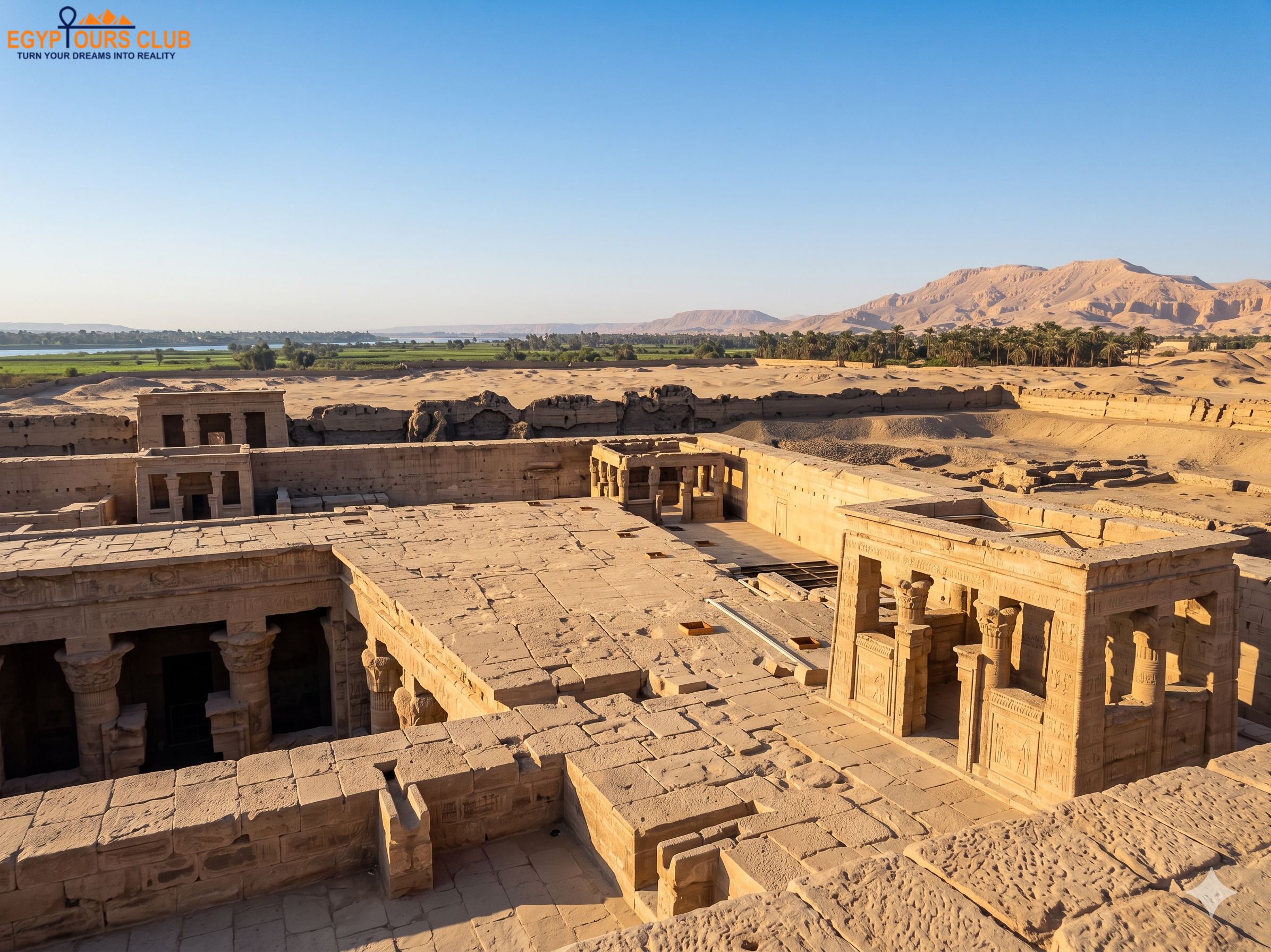
The site includes Dendera crypts, Dendera roof chapels, the Roman mammisi Dendera, and the broader sacred enclosure that also contained a sacred lake Dendera and additional shrines. The complex is known to include birth houses, a sacred lake, and multiple shrines within its walls.
5) It is ideal for cultural travel from Luxor
Because it is accessible as a Luxor to Dendera tour or Dendera Temple day tour, it works both as a serious historical site and as a highly practical excursion for travelers based in Luxor. Egypt’s official ticket portal lists the monument and current opening hours for visitors.
🎨 Hathor Goddess Egypt and the Meaning of the Temple
To understand the Temple of Hathor at Dendera, it helps to understand Hathor herself. In ancient Egyptian religion, Hathor was a complex and beloved goddess connected with the sky, fertility, love, women, beauty, music, joy, and motherhood. Britannica describes Hathor as goddess of the sky, of women, and of fertility and love, while Egypt’s official monuments platform highlights her association with music, joy, dance, and motherhood.
This matters because the Hathor goddess temple Egypt identity is visible everywhere in the monument:
- Hathor-headed columns
- symbolic reliefs
- ritual chambers
- celebratory and sacred imagery
- celestial associations
- festival and cultic meaning tied to divine femininity and renewal
That is why the Hathor Temple Dendera is not just an architectural masterpiece. It is also one of the most important religious monuments for understanding how divine identity was expressed visually in Egypt.
🏺 Architecture of the Temple of Hathor Dendera
Architecturally, the Temple of Hathor Dendera is one of the most impressive surviving sanctuaries in Egypt. Britannica describes the sandstone temple as approximately 79 meters long, enclosed within a very large mudbrick-walled sacred area, and emphasizes the great hypostyle hall supported by 18 Hathor-headed columns.
🔍 Architectural highlights
- monumental façade
- six massive entrance columns with Hathor heads
- large decorated hypostyle hall
- richly carved walls and ceilings
- roof-access areas and chapels
- hidden chambers and crypts
- placement inside a wider Dendera Temple Complex with multiple sacred structures
📊 Quick architecture table
| Feature | Description |
|---|---|
| Main monument | Temple of Hathor at Dendera |
| Location | Dendera, Qena, Egypt |
| Material | Sandstone temple within a mudbrick enclosure |
| Famous hall | Decorated hypostyle hall with 18 Hathor-headed columns |
| Style period | Mainly Ptolemaic and Roman |
| Visual identity | Reliefs, carvings, ceiling scenes, columns, roof spaces |
The reason so many people search for Dendera Temple columns, Dendera Temple interior, and Dendera Temple carvings is that the building still communicates power and beauty on a monumental scale.
🌌 Dendera Zodiac and the Dendera Temple Ceiling
No serious article on the Temple of Hathor Dendera is complete without a dedicated section on the Dendera zodiac and the Dendera Temple ceiling.
Britannica notes that the ceiling is carved with astronomical scenes, and this celestial program is one of the core reasons the site is globally famous. The association with the Dendera astronomical ceiling gives the temple an intellectual and symbolic dimension that goes beyond architecture alone.
Why the Dendera zodiac matters
- It links the temple to cosmic and celestial symbolism
- It gives Dendera a unique place among Egyptian temples
- It increases cultural and visual search demand
- It helps explain why this site fascinates both travelers and scholars
Why the Dendera Temple ceiling stands out
- richly carved astronomical imagery
- powerful visual storytelling
- unusual preservation
- strong photo appeal
- one of the clearest reasons the site is called the best preserved temple in Egypt
This is why keywords such as Dendera zodiac, Dendera Temple ceiling, Dendera astronomical ceiling, and colorful temple ceiling Egypt are essential to the article’s authority and topical depth.
🔐 Dendera Crypts, Roof Chapels, Roman Mammisi, and Sacred Lake
The Temple of Hathor at Dendera is not just a façade and a hall. The broader sacred environment adds major depth to the site.
The Dendera Temple Complex includes crypts, roof spaces, and chapels that enrich the visitor experience and strengthen the site’s symbolic meaning. The wider complex is also known for structures such as the Roman mammisi Dendera and a sacred lake Dendera, along with additional shrines and enclosed monuments.
Key elements beyond the main hall
- Dendera crypts for hidden and more mysterious ritual spaces
- Dendera roof chapels connected to sacred movement and elevated ritual space
- Roman mammisi Dendera reflecting birth-house symbolism
- sacred lake Dendera as part of the ritual landscape
- broader sacred enclosure with multiple monuments and shrines
These features make the Dendera Temple Complex far richer than a one-room visit. They also explain why a Temple of Hathor guided tour can add real value for visitors who want to understand the symbolism rather than simply walk through the temple.

🎭 Cleopatra Reliefs Dendera and Artistic Identity
Another reason the Temple of Dendera is so captivating is its artistic density. The monument is celebrated for its relief program, carvings, and visual coherence. Search interest around Cleopatra reliefs Dendera, Dendera Temple reliefs, and Dendera Temple photos reflects how visually powerful the site is for both scholarship and tourism.
What makes the art so striking?
- the Hathor-headed capitals
- densely carved ritual scenes
- strong preservation of sculptural detail
- decorative ceilings with celestial imagery
- visual storytelling tied to kingship and cult
This is why ancient Egyptian temple art Dendera is such a valuable keyword cluster. The temple is not important only because it survived. It is important because what survived is still artistically extraordinary.
📍 Dendera Temple Egypt Location and Why It Works as a Day Trip
The Temple of Hathor Egypt is located at Dendera in Qena Governorate, and it is commonly visited from Luxor. Egypt’s official booking portal for the site lists the monument as Dandarah Temple and gives current visitor hours.
Official visit hours
According to Egypt’s official monument booking page, Dandarah Temple is generally open:
- Summer: 7:00 am, last entry 4:00 pm
- Winter: 7:00 am, last entry 4:00 pm
- Ramadan: 8:00 am, last entry 3:00 pm
Why it works well for visitors
- easy to include in a Dendera Temple day tour
- popular as a Luxor to Dendera tour
- ideal for travelers wanting a major site beyond Luxor’s standard core stops
- strong option for culture-focused itineraries in Upper Egypt
Visitor table
| Visitor Info | Details |
|---|---|
| Site name | Temple of Hathor at Dendera |
| Region | Dendera, Qena, Egypt |
| Main travel base | Luxor |
| Best visit type | Dendera Temple day tour / Temple of Hathor guided tour |
| Official hours | 7:00 am opening; last entry usually 4:00 pm, Ramadan differs |
This section naturally supports your commercial keywords:
- Temple of Hathor guided tour
- Dendera Temple day tour
- Luxor to Dendera tour
- Dendera Temple tickets
🧳 Dendera Temple Day Tour: Who Should Visit?
A Dendera Temple day tour is ideal for several types of travelers:
- first-time visitors who want more than the standard Luxor circuit
- repeat Egypt travelers looking for depth
- art and architecture lovers
- historians and archaeology-minded visitors
- photographers interested in temple interiors
- travelers seeking one of the strongest cultural sites north of Luxor
Because the Temple of Hathor Dendera combines visual beauty, preservation, mythology, and practical accessibility, it has unusually broad appeal. It works equally well for a serious historian and for a traveler who simply wants to experience one of the most unforgettable temples in Egypt.

📸 What Makes the Temple of Hathor Dendera Visually Unforgettable?
Searches for Dendera Temple interior, Dendera Temple photos, Dendera Temple reliefs, and Dendera Temple ceiling all point to the same truth: this is one of the most photogenic and visually complete temples in Egypt.
Visual strengths of the temple
- monumental entrance
- recognizable Hathor-headed columns
- richly decorated hypostyle hall
- celestial ceiling imagery
- strong interior preservation
- high contrast between light, shadow, and carved stone
- memorable sacred atmosphere
That is why the temple performs so strongly not only as a historical subject but also as a visual destination.
❓ FAQs About the Temple of Hathor at Dendera
What is the Temple of Hathor at Dendera?
It is the principal sanctuary of the Dendera Temple Complex, dedicated to the goddess Hathor, and one of the best-preserved temples in Egypt.
Why is the Temple of Hathor important?
It is important because of its preservation, its role as Hathor’s main cult center, its astronomical ceiling decoration, and its outstanding artistic and historical value.
What is the Dendera zodiac?
The Dendera zodiac is the famous celestial imagery associated with the temple’s astronomical decoration, one of the most widely recognized symbolic features linked to Dendera.
Is the Temple of Hathor Dendera worth visiting?
Yes. It is one of the strongest cultural and visual temple experiences in Egypt, especially for travelers interested in art, religion, and architecture.
Can I visit Dendera from Luxor?
Yes. A Luxor to Dendera tour or Dendera Temple day tour is one of the most practical and rewarding excursions from Luxor. Official visitor hours are published on Egypt’s monument booking portal.
What are the official opening hours?
The official booking page lists 7:00 am opening and 4:00 pm last entry for summer and winter, with different Ramadan timing.
What makes the Dendera Temple ceiling famous?
The ceiling is renowned for its astronomical scenes and rich symbolic decoration, which help make the temple one of Egypt’s most visually important sacred sites.
Are there crypts and roof chapels at Dendera?
Yes. The complex is known for Dendera crypts, Dendera roof chapels, and related sacred spaces beyond the main hall.
🏁 Final Thoughts
The Temple of Hathor at Dendera is not simply another ancient monument in Upper Egypt. It is one of the clearest demonstrations of why Egyptian sacred architecture still moves visitors thousands of years later. It combines religious meaning, visual magnificence, architectural preservation, celestial imagery, and travel value in one extraordinary site.
For readers searching what is the Temple of Hathor at Dendera, studying the history of the Temple of Hathor at Dendera, or planning a Dendera Temple day tour, the conclusion is simple:
The Temple of Hathor Dendera is one of the most rewarding temples in Egypt, and one of the strongest cultural destinations for anyone exploring Upper Egypt.