


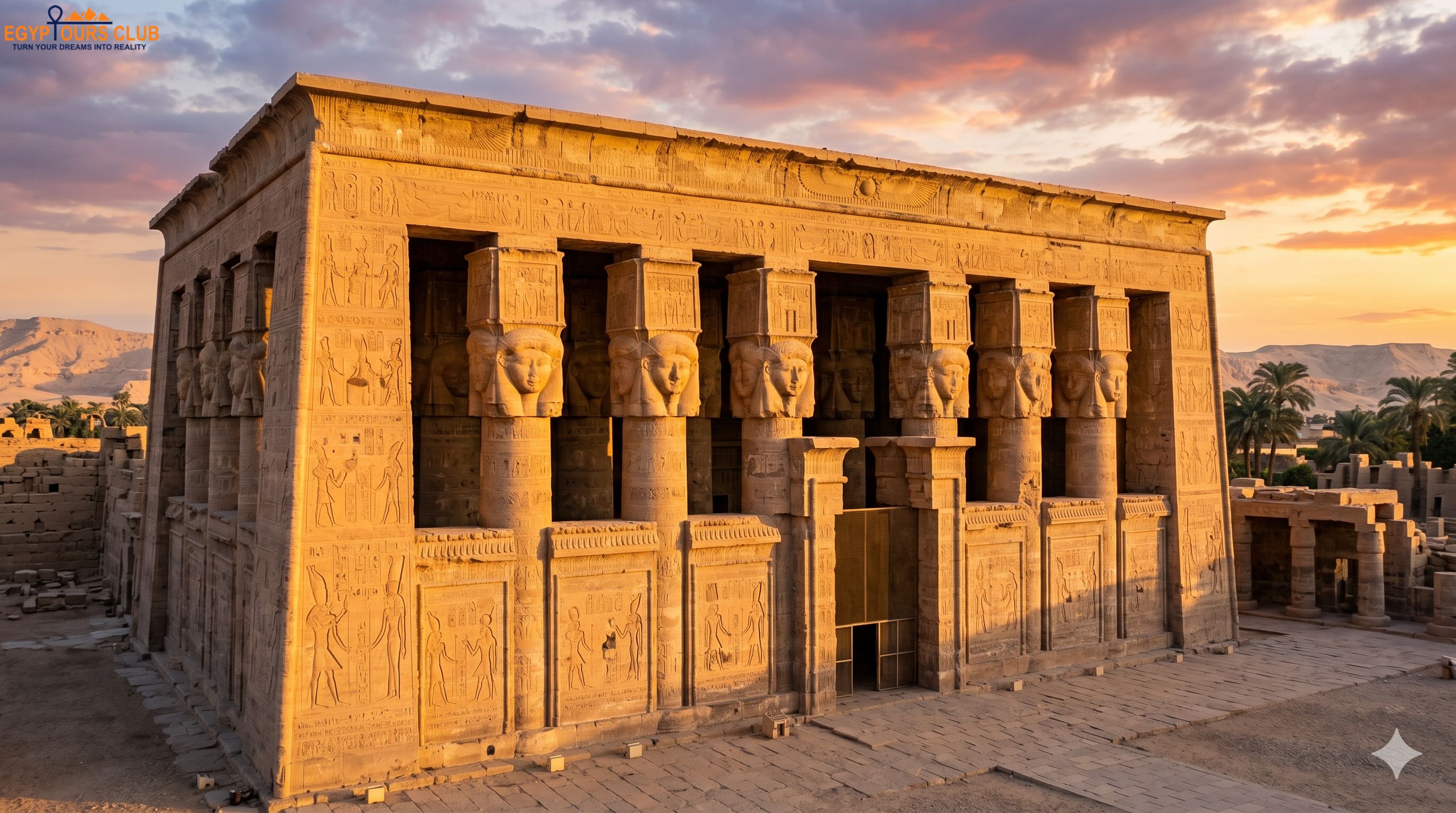
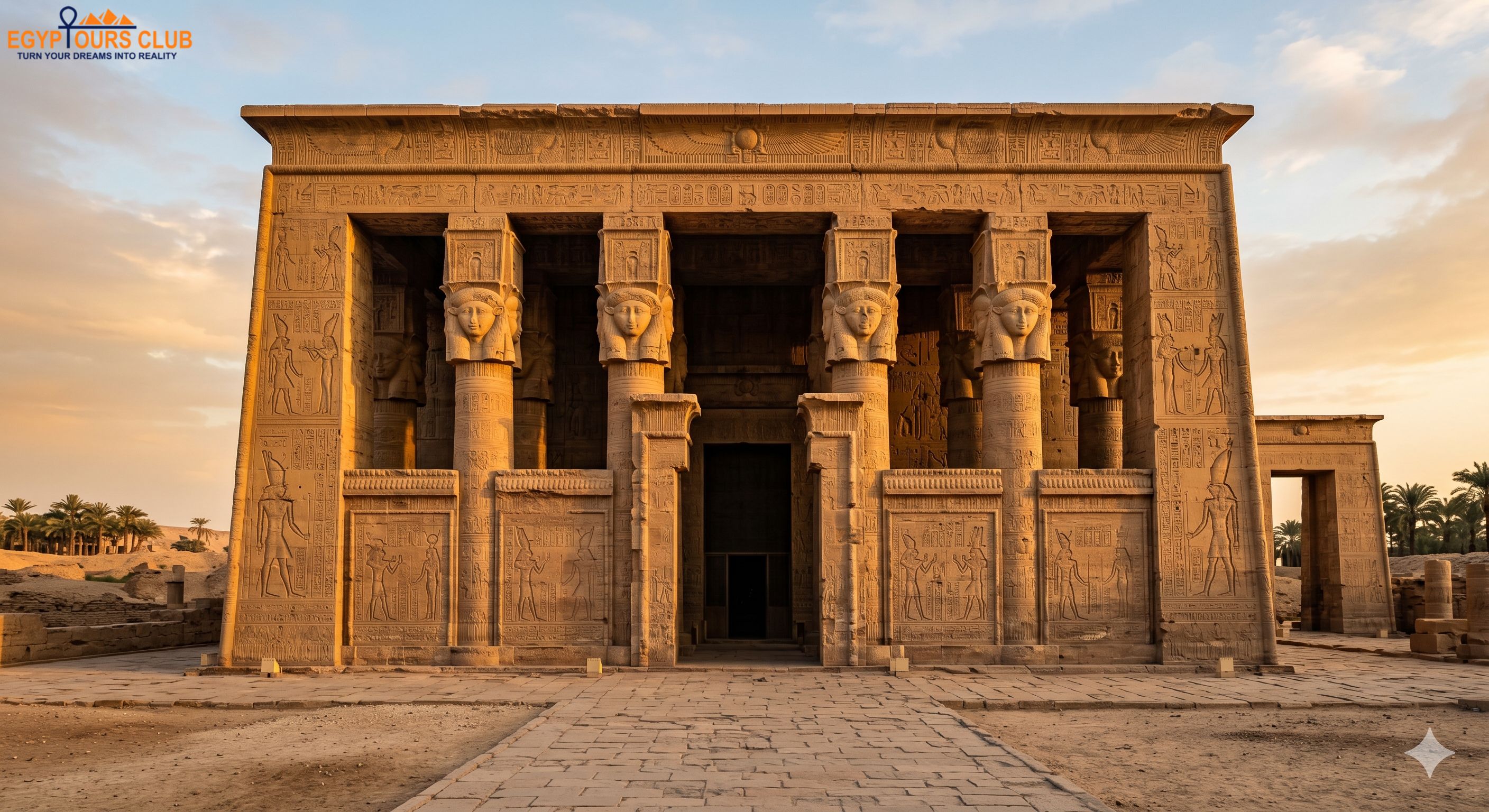
Monumental Entrance
The façade immediately introduces the visitor to the temple’s scale, sacred importance and visual strength.
A focused guide to Hathor’s main sanctuary inside Dendera, built to separate the temple interior story from the wider Dendera Temple Complex route.
The Temple of Hathor at Dendera is the core sanctuary inside the wider Dendera Temple Complex. This page focuses on Hathor symbolism, Hathor-headed columns, the famous Dendera zodiac ceiling, astronomical scenes, crypts and roof chapels. For the full site route, tickets, distance and broader planning, continue to the Dendera Temple Complex guide.
The Temple of Hathor at Dendera is the main sanctuary inside Dendera Temple Complex, famous for Hathor-headed columns, the Dendera zodiac ceiling, astronomical scenes, crypts and roof chapels. This page focuses on the temple interior and Hathor meaning, while the wider Dendera Temple Complex page covers the full site route, tickets, distance from Luxor and broader tour planning.
Use this page when the search is specifically about Temple of Hathor at Dendera, the Dendera zodiac ceiling, Hathor-headed columns, crypts, roof chapels and sacred interior details. Use the Dendera Temple Complex guide for the complete site overview, tickets, distance from Luxor to Dendera Temple, and broader Dendera tour planning.
The Temple of Hathor at Dendera is not just part of a complex; it is the emotional and architectural center of Dendera’s sacred landscape. Its halls, columns, reliefs and ceiling decoration create one of the clearest examples of how Egyptian temples combined beauty, ritual, mythology and cosmic order.
Hathor’s identity appears everywhere: in the column capitals, sacred scenes, festival meaning, celestial decoration and the atmosphere of renewal that defines the temple. This is why searches for Hathor Temple Dendera, Temple of Hathor Dendera, Dendera Temple ceiling, Dendera zodiac ceiling and Hathor goddess temple Egypt all point to the same essential experience.
The current standing temple belongs mainly to the Ptolemaic and Roman periods, but Dendera’s sacred importance is older. The result is a temple that feels both ancient and surprisingly intact, making it one of the strongest cultural stops north of Luxor.
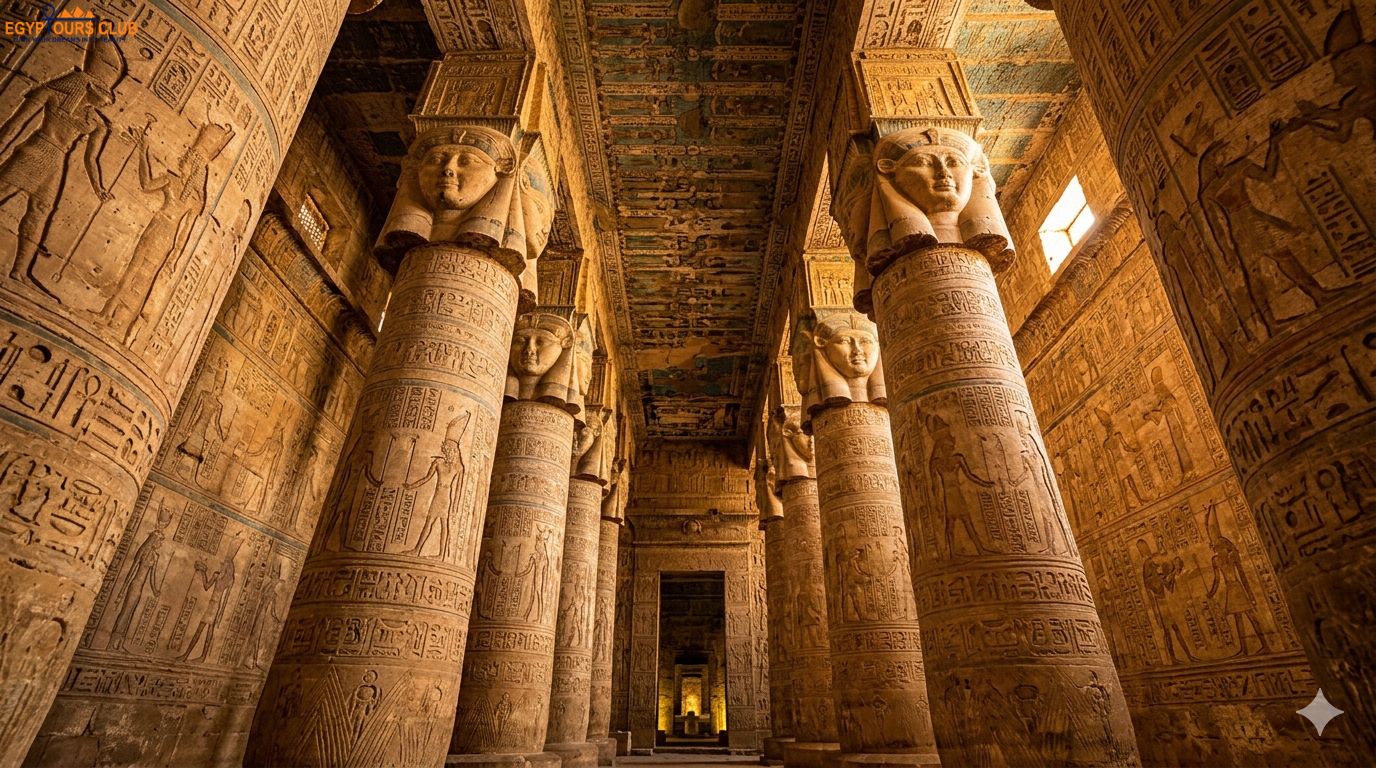
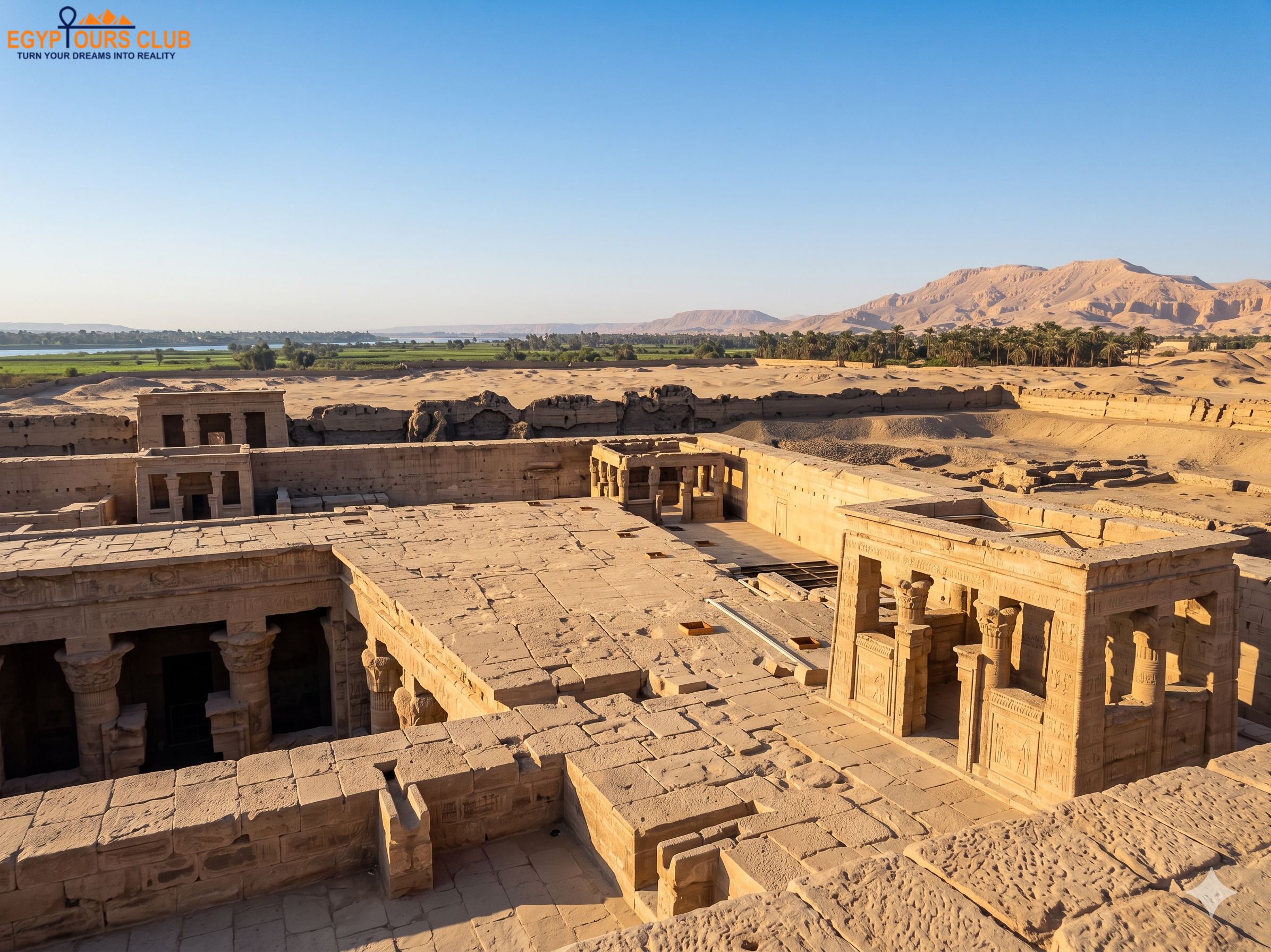
Temple of Hathor · DenderaThe temple’s visual story begins at the entrance, grows inside the decorated hypostyle hall, and rises toward roof chapels linked with celestial and ritual meaning.
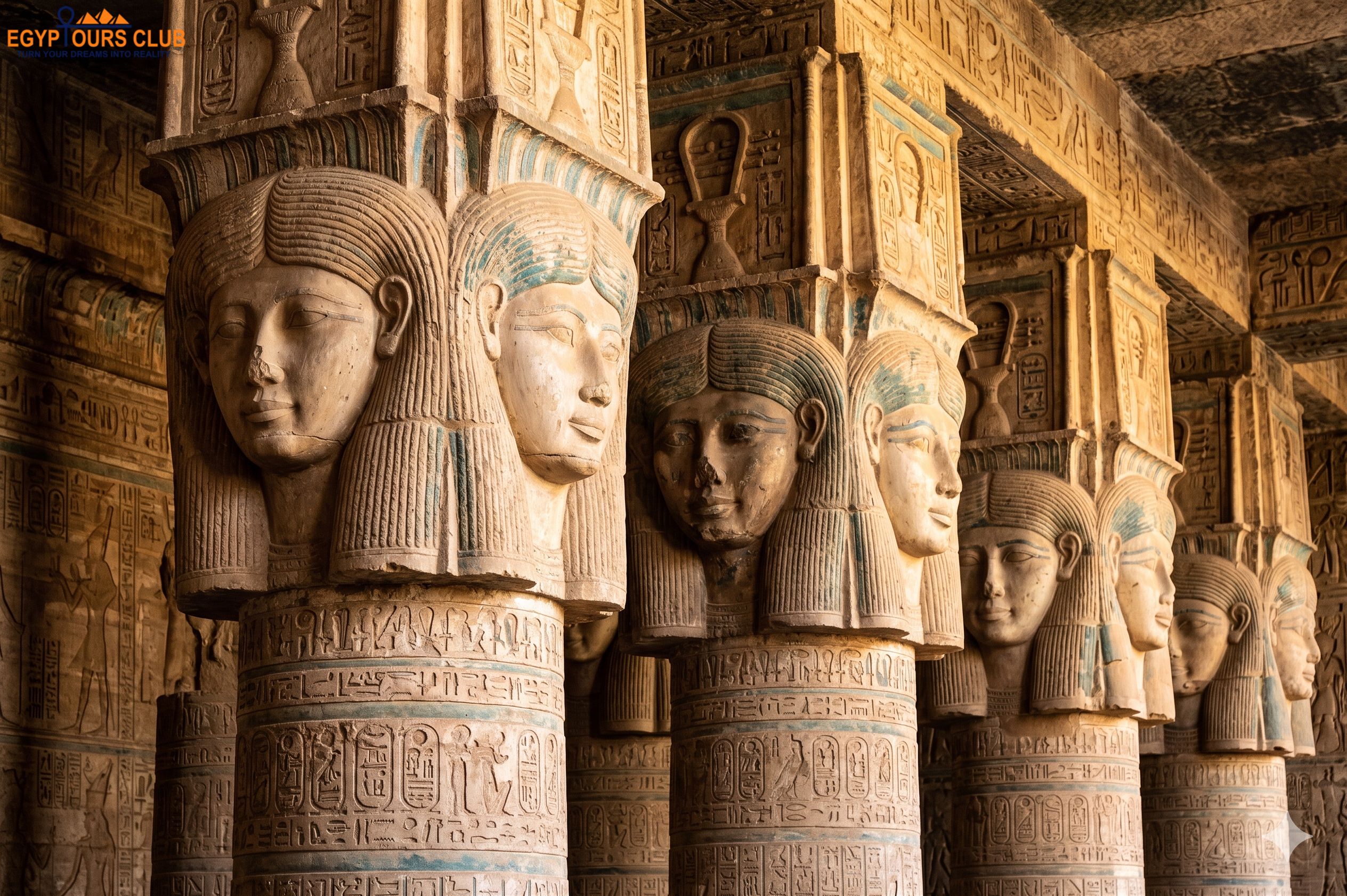
To understand the temple, you must first understand Hathor. She was associated with joy, music, dance, motherhood, beauty, love, fertility and the sky, and Dendera was her great cult center.
The temple is important because it preserves the full experience of an Egyptian sacred building: façade, hall, columns, ceilings, chambers, crypts, roof chapels and ritual meaning.
The façade immediately introduces the visitor to the temple’s scale, sacred importance and visual strength.
The iconic columns give the temple its identity and make Hathor’s presence visible throughout the hall.
The ceiling decoration connects the temple with celestial symbolism, divine order and the famous Dendera zodiac tradition.
The roof spaces add ritual depth and help visitors understand the temple as a multi-level sacred environment.
The walls and chambers preserve ritual imagery, divine encounters, offerings and symbolic scenes in impressive detail.
The temple feels unusually complete, which is why it is one of Egypt’s strongest surviving sacred monuments.
The Dendera zodiac and astronomical ceiling are central to the temple’s global fame. They give the site an intellectual and symbolic dimension beyond architecture alone.
| Feature | What It Means | Why It Matters for Visitors |
|---|---|---|
| Dendera zodiac | Celestial imagery associated with the temple’s sky symbolism | Makes the temple one of the world’s most discussed Egyptian sacred sites. |
| Astronomical ceiling | Carved and painted sky-related scenes above the sacred hall | Turns the visit into an experience of art, religion and cosmic order. |
| Hathor and the sky | Hathor’s divine identity connects with sky, renewal and celestial protection | Explains why Hathor’s temple is strongly linked with ceiling imagery. |
| Guided interpretation | A guide helps connect symbols, spaces and ritual meaning | Prevents the visit from becoming only a photo stop. |
The strongest choice depends on whether you want a focused Dendera visit, a complete Dendera and Abydos day trip, or a wider Upper Egypt temple route.
| Tour Option | Best For | Suggested Route | Action |
|---|---|---|---|
| Guided Dendera Tour from Luxor | Travelers focused on Hathor Temple | Luxor → Temple of Hathor → Dendera Complex → Luxor | Request guided Dendera route |
| Dendera and Abydos Temples Tour | Full-day Upper Egypt temple travelers | Dendera Temple → Abydos Temple of Seti I → return to Luxor | Book Dendera & Abydos |
| Dendera Zodiac and Temple Art Route | Art, symbolism and photography lovers | Hypostyle Hall → Zodiac Ceiling → Crypts → Roof Chapels | Customize guided visit |
| Upper Egypt Temple Journey | Multi-day Egypt travelers | Luxor → Dendera → Abydos → Esna → Edfu → Kom Ombo → Aswan | Explore Egypt packages |
The Temple of Hathor is commonly visited from Luxor as a guided day trip. It also works beautifully with Abydos for travelers who want a full Upper Egypt sacred route.
| Route | Best For | Suggested Flow | Useful Link |
|---|---|---|---|
| Temple of Hathor Day Trip | Travelers based in Luxor | Luxor → Temple of Hathor → Dendera Complex → return to Luxor | Guided Dendera day trip |
| Dendera and Abydos Full Day | Serious temple travelers | Luxor → Temple of Hathor Dendera → Abydos Temple of Seti I → Luxor | Dendera and Abydos tour |
| Upper Egypt Temple Route | Repeat Egypt visitors | Luxor → Dendera → Abydos → Esna → Edfu → Kom Ombo → Aswan | Luxor day tours |
| Custom Sacred Architecture Journey | Slow travel and specialist interests | Guide-led route around Hathor, ceiling symbolism, crypts, roof spaces and sacred architecture | Tailor made Egypt tours |
These details help the page add real planning value and keep the visit focused on Hathor’s sanctuary rather than repeating the broader Dendera guide.
Use these pages to connect the Temple of Hathor with Dendera Complex, Abydos, Luxor and the wider Upper Egypt temple route.
It is the main sanctuary inside Dendera Temple Complex, dedicated to the goddess Hathor and famous for its preserved halls, columns, ceiling scenes and sacred chambers.
It is important because it is one of Egypt’s best-preserved temples and one of the strongest surviving monuments for understanding Hathor worship, sacred architecture and celestial symbolism.
The Dendera zodiac is the famous celestial imagery associated with the temple’s astronomical decoration and one of the main reasons the site is known worldwide.
Yes. It is commonly visited as a guided Luxor to Dendera day tour and can also be combined with Abydos Temple in a full-day trip.
Main highlights include the Hathor-headed columns, decorated hypostyle hall, astronomical ceiling, relief scenes, crypts, roof chapels and sacred chambers.
Yes. It is one of the most complete and visually powerful temple visits in Egypt, especially for travelers interested in art, architecture, mythology and photography.
If you have limited time, Dendera alone is excellent. If you have a full day, combining Dendera and Abydos creates one of the strongest temple routes from Luxor.
Most visitors should allow enough time for the façade, hall, ceiling, crypts, roof chapels and guide explanation rather than treating it as a quick photo stop.
Visit Hathor’s sanctuary with a guided guide, then connect the zodiac ceiling, Hathor columns, crypts and roof chapels with Abydos, Luxor and the wider sacred route of Upper Egypt.