


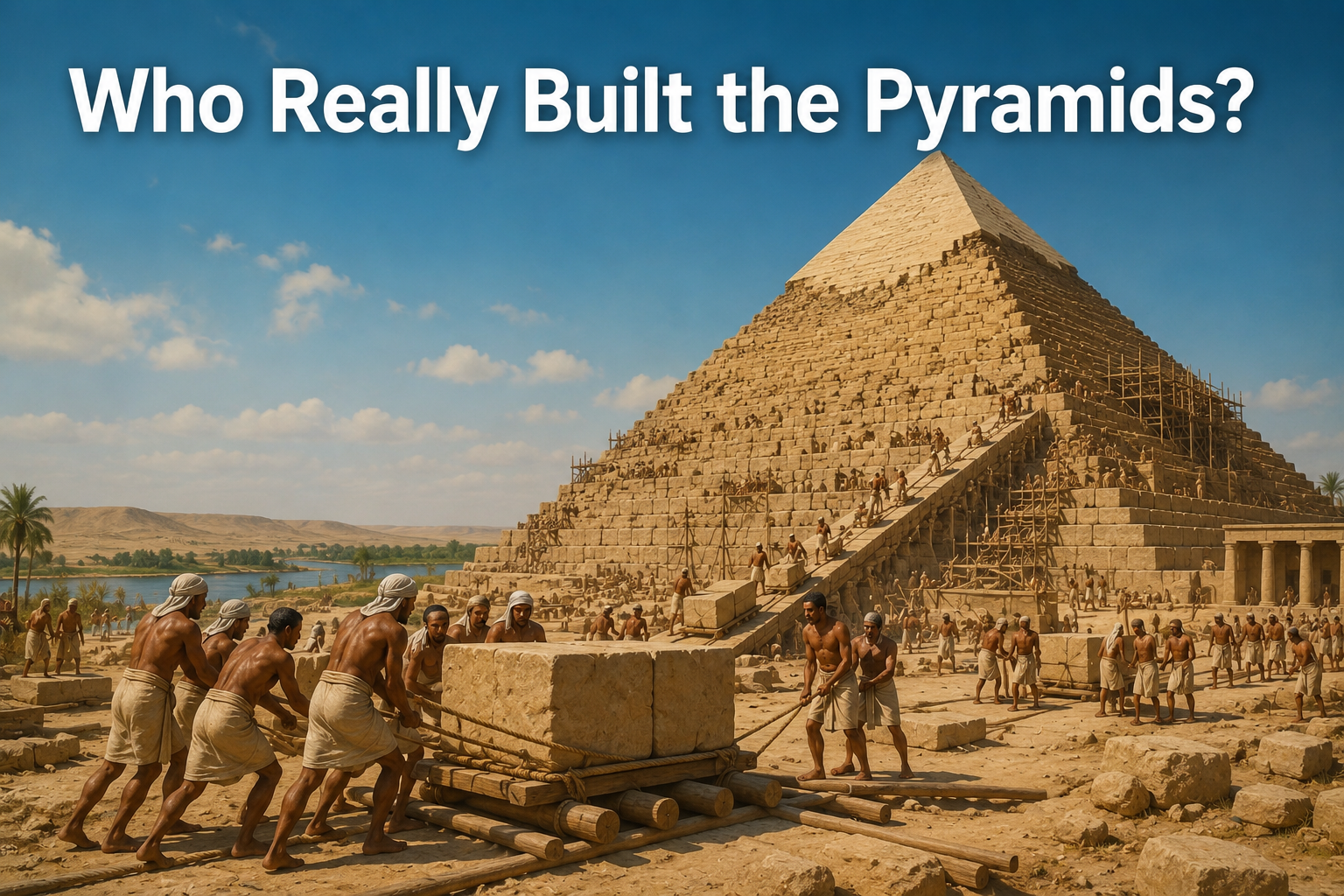
Who Really Built the Pyramids?
Follow the archaeological evidence from workers’ settlements, cemeteries, administrative records and an ancient inspector’s diary.
Workers’ cityMerer’s papyriMyths vs evidenceThe evidence does not support the popular image of vast chains of enslaved people. Excavations around the Giza Pyramids reveal a complex, organized workforce living close to the construction site.
The strongest evidence

Workers’ cemetery
Burials beside the settlement include overseers and skilled craftspeople. Healed injuries suggest care after demanding physical work.

Heit al-Ghurab
The settlement contained houses, galleries, streets, storage and royal administration serving pyramid projects.

Merer’s diary
Papyri describe a crew transporting fine limestone from Tura toward Khufu’s pyramid project.
Who were the builders?
Stonecutters, masons, surveyors, haulers, carpenters and toolmakers.
Cooks, bakers, brewers, administrators, guards and medical personnel.
Teams drawn from Egyptian communities, likely serving scheduled state obligations.
How were they supported?
Animal bones and food remains show substantial supplies of cattle, sheep, goats, fish and birds. Storage facilities and administrative buildings point to planned provisioning rather than an improvised mass camp.
Named crews and organization
Work gangs used identities and team names, while supervisors coordinated transport and tasks. Merer’s log is especially valuable because it records daily movement of limestone during Khufu’s reign and connects real crews to the Great Pyramid project.
Myths and evidence
- Myth: aliens built the pyramids. Evidence: Egyptian tools, quarries, settlements, records and a long architectural development from earlier pyramids.
- Myth: no human workforce could organize the project. Evidence: the remains show administration, supply chains and specialized teams.
- Myth: every builder was a chattel slave. Evidence: nearby burials, provisioning and medical care describe a more complex labor system.
How did they build them?
No single complete construction manual survives. Archaeologists combine quarry marks, tools, unfinished monuments, transport records and engineering experiments. Ramps, sledges, ropes, levers and coordinated labor almost certainly played roles, although the exact ramp configuration remains debated.
Frequently asked questions
Were the pyramids built by slaves?
The archaeological record supports organized Egyptian labor forces with specialists and rotating teams, not the familiar mass-slave stereotype.
How many workers built the Great Pyramid?
Estimates vary because no complete roster survives. Modern research generally favors a workforce far smaller and more organized than older claims of 100,000 laborers.
What is Merer’s diary?
A group of papyri recording an inspector and his crew transporting limestone connected with Khufu’s pyramid project.
Do we know exactly how the pyramids were built?
We know much about quarrying, transport and organization, but some engineering details—especially ramp design—remain debated.
See the evidence at Giza
Explore the pyramid complexes with an Egyptologist who connects the monuments with the people behind them.
Explore Cairo Tours