

For more than 4,500 years, the Great Pyramid of Giza has stood as humanity's most studied structure — yet it may still hold rooms no living person has ever entered. Science has now confirmed it. Here is everything the evidence actually shows, separated from the myths.
What Do We Actually Know? A Clear-Cut Breakdown
Searches for hidden chambers under pyramids conflate three different categories of space. Understanding that distinction is key — and it separates credible Egyptology from sensationalist headlines.
| Category | Definition | Status | Best Example |
|---|---|---|---|
| Known Internal Chambers | Rooms fully documented inside a pyramid's body | Confirmed & accessible | King's Chamber, Grand Gallery — Khufu's Pyramid |
| Known Subterranean Spaces | Passages or chambers cut below the pyramid into bedrock | Confirmed & studied | Unfinished underground chamber, Great Pyramid |
| Newly Detected Voids | Hidden spaces found by non-invasive scanning, not yet fully characterised | Scientifically confirmed, interpretation ongoing | ScanPyramids Big Void · North Face Corridor (2023) |
| Speculated Secret Rooms | Theorised spaces without physical or scientific confirmation | Unconfirmed | "Hidden entrance pyramid Egypt" conspiracy theories |
Are There Hidden Chambers Under the Pyramids? The Evidence-Based Answer
The short answer is yes — and not just theory. Scientific instruments have confirmed previously unknown spaces inside Khufu's Great Pyramid using muon radiography, the same particle-physics technique used to peer inside volcanoes and nuclear reactors without drilling a single hole.
The confusion often arises from the word "under." Some hidden spaces are genuinely beneath the pyramid — cut into the bedrock below its base. Others are inside the pyramid's stone body, above ground level. Both types are real. Both matter. And neither is the same as the fanciful "secret city under the Sphinx" stories that circulate online.
How Muon Radiography Works
Muons are high-energy particles produced naturally when cosmic rays strike the upper atmosphere. They pass through rock the way X-rays pass through flesh — denser material stops more muons. By placing detectors inside a pyramid and measuring which paths carry fewer particles, scientists can map voids without touching the stone. This is the technology behind the ScanPyramids discoveries.
If you are planning a visit to stand at the base of these monuments yourself, our expert-guided Cairo day tours include access to the Giza plateau, the interior chambers, and the Sphinx — all with licensed Egyptologist guides who bring the science to life on-site.
A Timeline of Major Pyramid Chamber Discoveries
Caliph Al-Ma'mun Forces Entry
Workers tunnelled into the Great Pyramid and reportedly found the King's Chamber already empty — its contents, if any, long removed or never placed there.
John Greaves Surveys the Interior
British astronomer John Greaves produces the first scientific measurements of the internal passages, establishing a baseline still referenced today.
The Queen's Chamber Air Shafts Explored
Waynman Dixon discovers two small shafts in the Queen's Chamber, reigniting debate about the pyramid's symbolic internal architecture.
Upuaut Robot Reaches a Door
Rudolf Gantenbrink's robot climbs one of the Queen's Chamber shafts and discovers a stone "door" with copper handles — hinting at a space beyond. A chamber behind it was partially explored in 2002, revealing another blocking stone.
ScanPyramids Confirms the Big Void
Three independent muon-radiography teams simultaneously confirm a large hidden space above the Grand Gallery — the first major internal discovery in centuries. Published in Nature.
North Face Corridor Imaged
Using next-generation muon detectors and an endoscope, researchers image a 9-metre corridor behind the north-face chevrons, marking another leap in non-destructive pyramid exploration.
Pyramid Hidden Chambers Explained: A Three-Part Framework
The clearest way to understand pyramid hidden chambers is to separate them into three categories based on the strength of current evidence:
King's Chamber
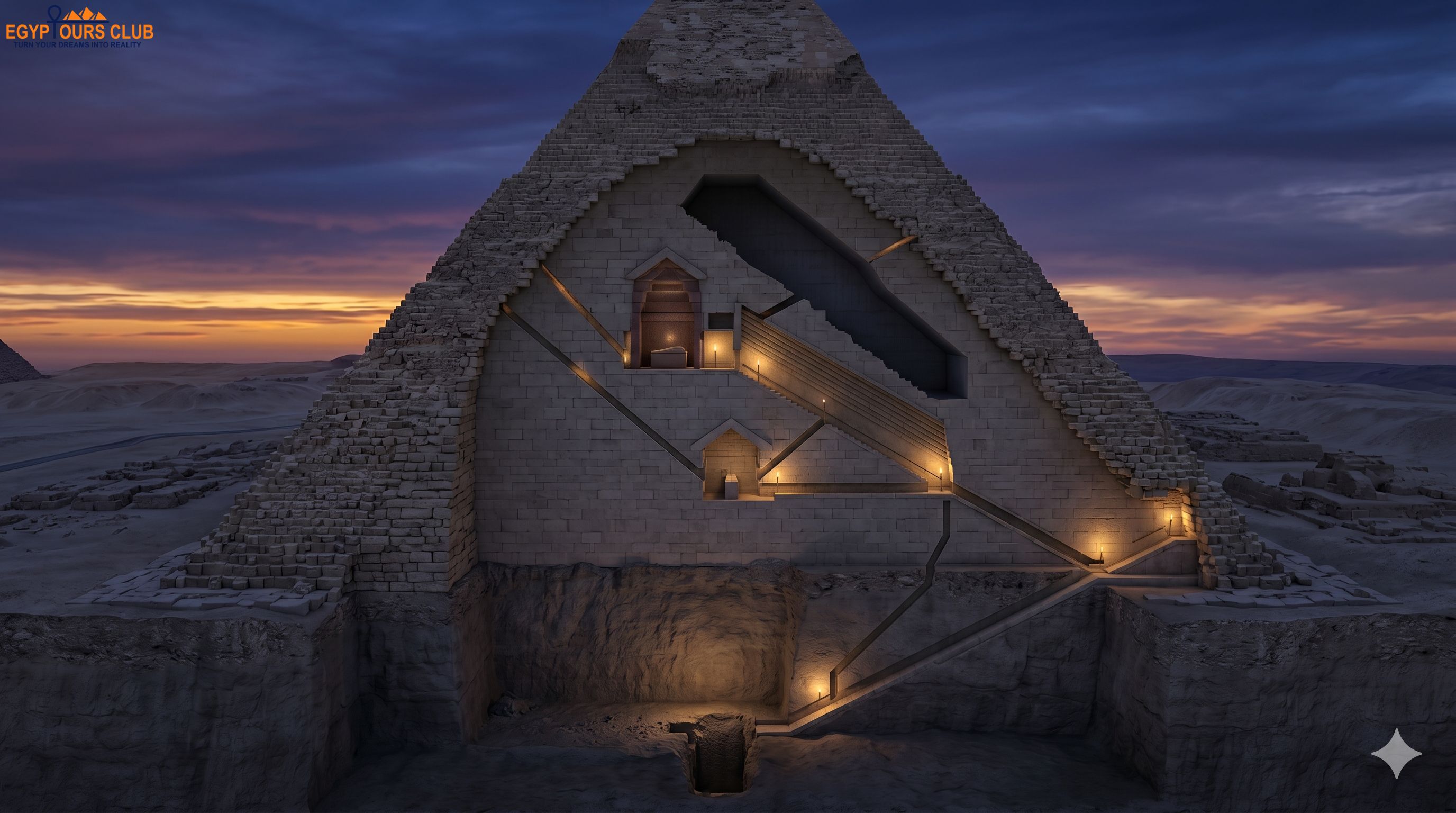
The primary granite burial chamber, accessible via the Grand Gallery. It contains the red granite sarcophagus of Khufu — empty since antiquity.
Queen's Chamber
A smaller chamber below the King's, named by Arab explorers. Its true function remains debated — it may never have housed a queen.
Grand Gallery
A soaring corbelled passageway 47 metres long leading to the King's Chamber — one of the most extraordinary architectural achievements of the ancient world.
Unfinished Underground Chamber
Cut into the bedrock approximately 30 metres below the base. Its abandonment before completion suggests a change in the original burial plan.
The Big Void
At least 30 metres long, above the Grand Gallery. Confirmed by three independent muon teams in 2017. Purpose still unknown — it may be structural, ritual, or neither.
North Face Corridor
Approximately 9 metres long, hidden behind the north chevrons near the pyramid's original entrance. Imaged but not yet accessed in 2023.
Possible Relieving Chambers
Stress-distribution spaces above the King's Chamber already exist (Davison's and Wellington's Chambers). Some researchers believe additional ones may remain undiscovered.
Undiscovered Burial Space
Some Egyptologists theorise that the pyramid's true burial chamber — if one exists — may still be undetected, potentially hidden behind false passages.
Why Were Secret Spaces Built Into Pyramids?
Not every void is automatically a tomb or treasure room. Pyramid architects working in the Fourth Dynasty (c. 2575–2465 BCE) were solving genuinely difficult engineering problems, and several of their solutions created "hidden" spaces as a byproduct:
1. Stress Relief & Weight Distribution
Above the King's Chamber sit five low-ceilinged relieving chambers whose sole purpose is to distribute the immense weight of stone pressing down from above. These spaces are not ritual — they are structural. The Big Void may be another such relieving feature, constructed during the build process and later sealed.
2. Construction Logistics
Internal ramps, passages, and temporary chambers used during construction may have been sealed after completion. Some researchers believe the geometry of the Big Void fits a hypothetical internal construction corridor theory proposed by architect Jean-Pierre Houdin.
3. Ritual & Symbolic Architecture
Egyptian pyramid design was deeply symbolic. Ascending passages represented the pharaoh's journey toward the sky. Lower subterranean chambers linked to the underworld and the god Osiris. Some hidden spaces may have had deliberate ritual meaning rather than purely practical functions.
4. Security & Misdirection
False passages and sealed corridors were standard practice in tomb design precisely to frustrate thieves. The Great Pyramid's blocking stones, hidden entrance, and complex passage geometry all point to deliberate concealment — which means more voids may exist simply as decoys or barriers.
Beyond Giza: Secret Chambers in Other Egyptian Pyramids
Most headlines focus on Khufu's Pyramid, but the Pyramid field stretches far beyond Giza. Khafre and Menkaure both contain lower passage systems and subterranean spaces. Dahshur's Bent Pyramid — which changed angle mid-construction — has two separate internal systems accessible to visitors. Saqqara's Step Pyramid complex includes an entire hidden underground city of tunnels and galleries beneath the main structure, most of which remain sealed. These sites reward visitors who go beyond the famous three.
Planning Your Visit: What Travellers to Giza Actually Experience
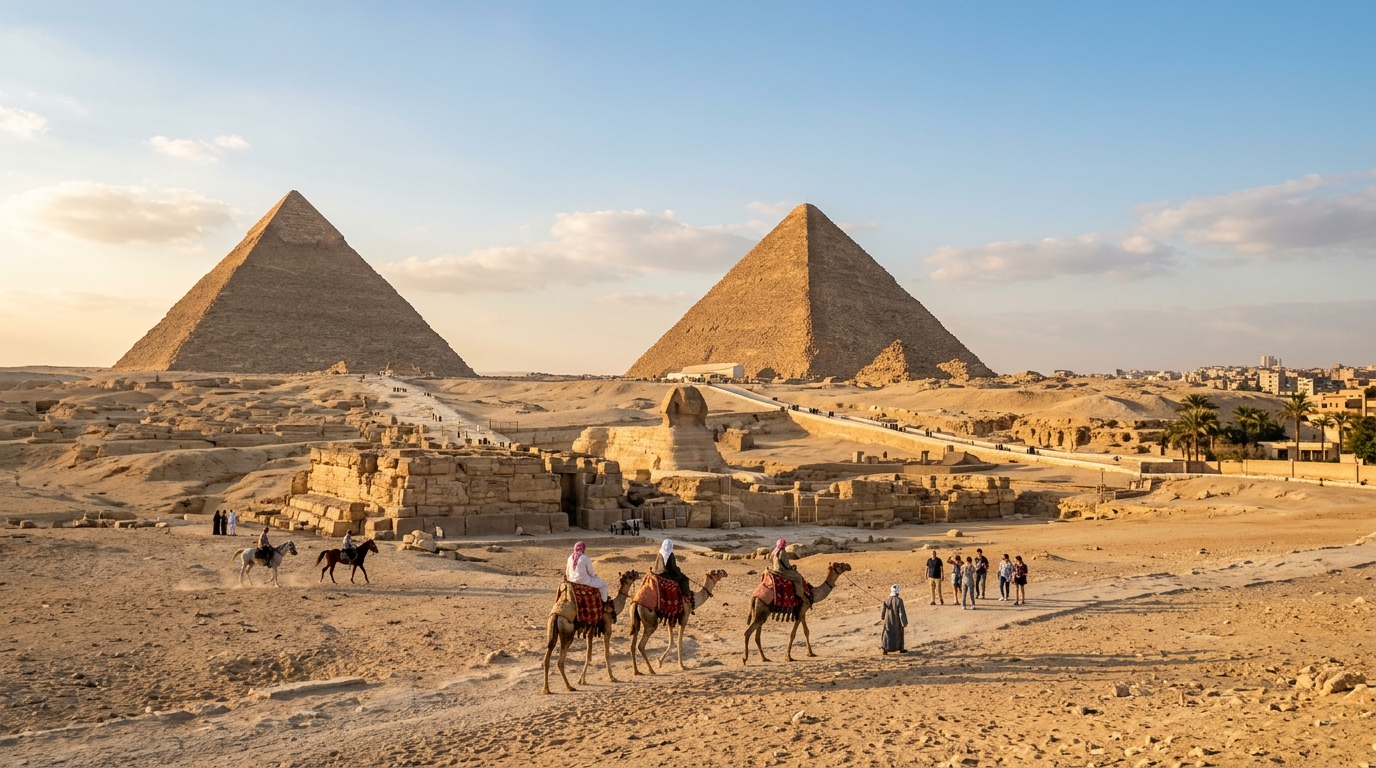
Standing at the base of the Great Pyramid in Giza — just 20 minutes by car from central Cairo — you are standing above millennia of secrets. Here is what visitors can access today versus what science is still working to understand:
| Space | Visitor Access | Ticket Required |
|---|---|---|
| Giza Plateau & Exterior | ✅ Fully open | Standard plateau ticket |
| King's Chamber (interior) | ✅ Open with quota | Interior access ticket (limited daily) |
| Grand Gallery | ✅ Part of interior tour | Interior access ticket |
| Queen's Chamber | ⚠️ Periodically open | Separate ticket when available |
| The Big Void | ❌ Not accessible | Under ongoing scientific study |
| North Face Corridor | ❌ Not accessible | Too narrow; under investigation |
Interior access tickets are sold separately at the site and are limited in daily quantity. We recommend booking a private guided tour rather than visiting independently — your guide can secure the interior tickets and explain the significance of each chamber in context.
Related Topics & Destinations You'll Love
Guided Tours to the Pyramids & Beyond
Our expert-led private tours take you inside the monuments, across the plateau, and through Egypt's greatest sites — with licensed Egyptologist guides who bring the history to life.
Grand Egyptian Museum, Giza Pyramids & Great Sphinx — Private Day Tour
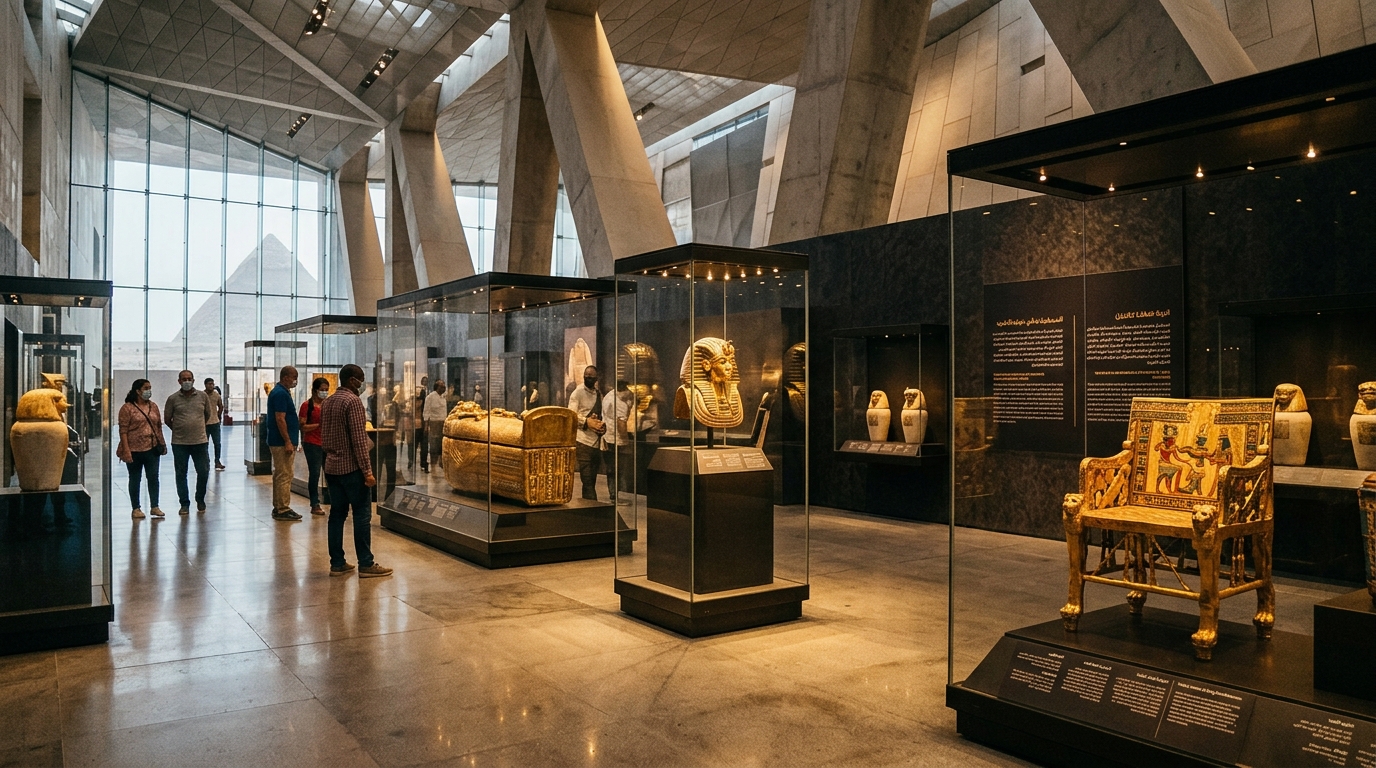
Stand face-to-face with Khufu's Great Pyramid, explore the King's Chamber interior, see the Sphinx, and finish at the world's largest archaeological museum — all in one extraordinary private day.
View Tour & BookSaqqara, Dahshur & Giza Pyramids — Full Evolution of Pyramid Architecture
Trace 200 years of pyramid evolution in a single day — from Djoser's revolutionary Step Pyramid at Saqqara, to the experimental Bent and Red Pyramids at Dahshur, to the perfect form achieved at Giza.
View Tour & BookSaqqara Necropolis Day Tour — Step Pyramid, Unas Pyramid & The Serapeum
Egypt's oldest pyramid complex conceals subterranean tunnels, royal tombs with painted hieroglyphs, and the Serapeum — an underground gallery of giant granite sarcophagi that still confounds archaeologists.
View Tour & BookSaqqara, Memphis & Giza Pyramids — One Day, Three Eras
Begin at the ancient capital Memphis, walk among the Old Kingdom monuments of Saqqara, then arrive at the Giza Plateau as the afternoon light turns the limestone gold — the perfect introduction to pharaonic Egypt.
View Tour & Book