

Luxor Museum | Visitor Guide, Royal Mummies & Ancient Theban Treasures | Egypt Tours Club
Luxor Museum . banner

Luxor Museum

Skip to the Luxor Museum guide

Luxor East Bank · Archaeological museum of ancient Thebes

Luxor Museum: Tickets, Hours & Ancient Thebes Masterpieces

Explore a selective collection of Theban masterpieces: statues from the Luxor Temple cachette, Akhenaten talatat reliefs, objects linked to Tutankhamun, and the royal mummies of Ahmose I and Ramesses I.

Luxor Temple cachette Royal mummies Akhenaten Tutankhamun Ancient Thebes

Quick travel answer

Is Luxor Museum worth visiting?

Luxor Museum is worth visiting because it presents a small number of exceptional works with space, light, and clear context. The collection connects the galleries directly to the monuments of ancient Thebes visited on Luxor's East and West Banks.

The principal highlights are the cachette statues discovered at Luxor Temple in 1989, the reconstructed talatat blocks from Akhenaten's temple at Karnak, selected objects from Tutankhamun's tomb, and the mummies of Ahmose I and Ramesses I.

Allow 1.5–2 hours. For a coherent route, combine the museum with Luxor Temple or Karnak Temples, where many of the displayed works originated.

At a glance

A museum built to explain ancient Thebes through its masterpieces

Unlike large encyclopedic collections, Luxor Museum emphasizes complete works, local provenances, and a readable route through the Middle Kingdom, New Kingdom, and later periods.

01

Best for

Egyptology, royal sculpture, Amarna art, Theban history, finds from Karnak and Luxor, and museums with focused displays.

02

Focused visit

Use about 90 minutes for the principal masterpieces or 2 hours to read the labels and explore both sections at a relaxed pace.

03

Top priorities

Luxor Temple cachette, Sobek and Amenhotep III group, Akhenaten talatat, Tutankhamun objects, and royal mummies.

04

Best pairing

Karnak in the morning, the museum during its evening session, and illuminated Luxor Temple after sunset make a strong East Bank route.

05

Getting there

The museum stands on the East Bank Corniche. Walk from central hotels or arrive by taxi, private car, or guided transfer.

06

Guide value

An Egyptologist guide connects the works to the courts, pylons, and tombs where they were discovered and to the historical events they represent.

1975 · 1989 · 2004

From Mahmoud El-Hakim's vision to an expanded museum of Theban collections

Egyptian architect Mahmoud El-Hakim designed Luxor Museum as a modern museum building overlooking the Nile. Inaugurated in 1975, it was created to preserve and present Theban finds in a selective display rather than an overcrowded storehouse arrangement.

The 1989 discovery in Amenhotep III's court at Luxor Temple transformed the collection: a cachette of 26 New Kingdom and later statues yielded exceptionally preserved works, many now displayed in the museum.

A wing opened in 2004, expanding the route with the reconstructed Akhenaten talatat reliefs, visitor facilities, and the royal mummy hall containing Ahmose I and Ramesses I.

The project takes shape

Mahmoud El-Hakim prepares plans for a contemporary museum dedicated to antiquities from the Theban area.

The museum opens to the public

The building opens on the Luxor Corniche with a selection of works from the region.

The cachette is discovered

A deposit of 26 statues emerges at Luxor Temple and becomes one of the museum's most important collection groups.

The new wing opens

The route expands to include Akhenaten's talatat and the royal mummies of Ahmose I and Ramesses I.

A reference point for Theban art

The museum connects selected masterpieces to Luxor's temples, tombs, and monumental history.

Luxor Museum facade and entrance on the Nile Corniche
The modern 1975 building was designed to give the works of ancient Thebes space and visual emphasis.

Masterpieces to recognize

Six unmissable Luxor Museum works and collection groups

Objects may be moved temporarily for conservation or redisplay. Use these groups to orient your visit and check for any gallery closures on arrival.

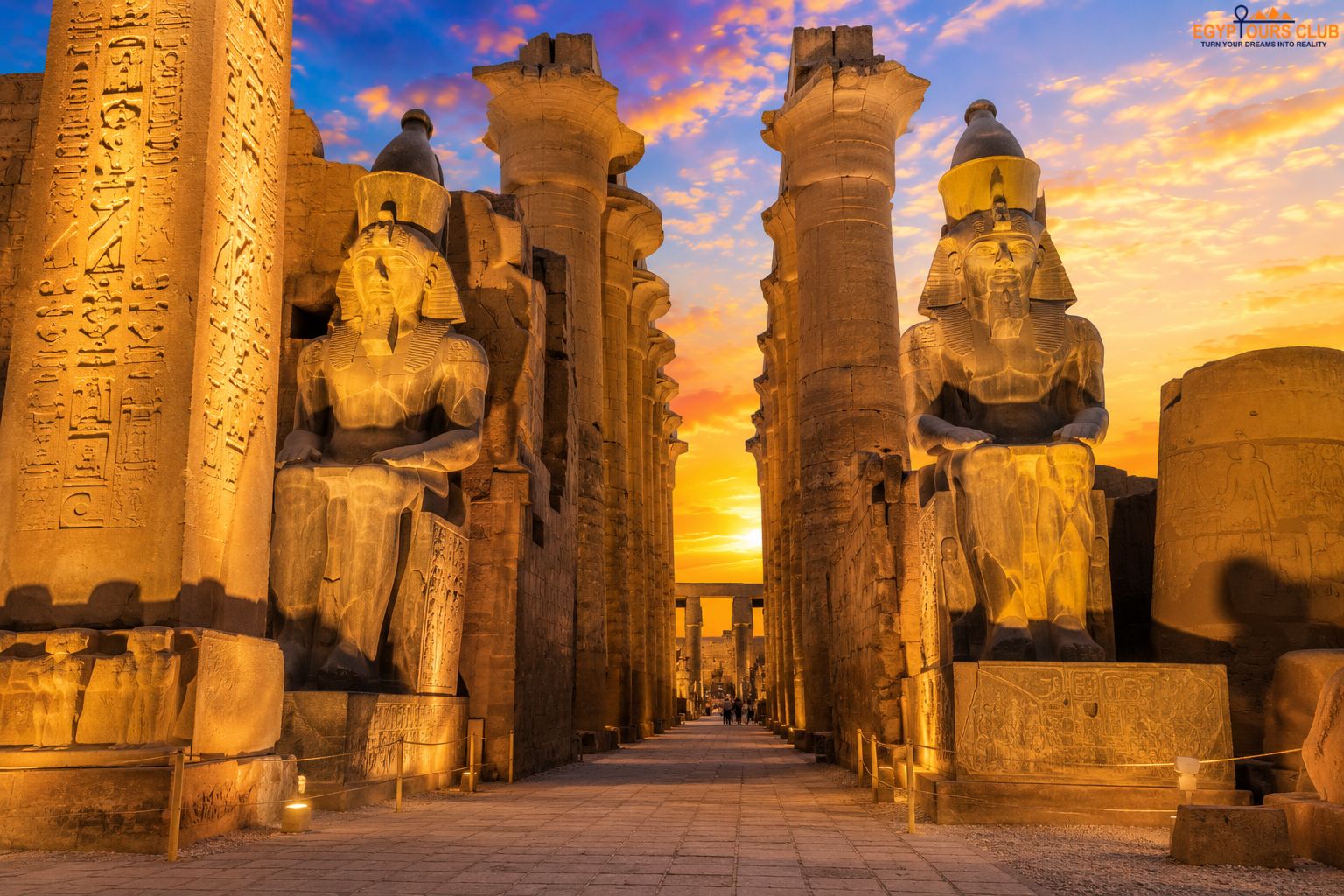
Illuminated Luxor Temple, discovery site of the statue cachette
1989 discovery

Luxor Temple cachette statues

The deposit found beneath the temple floor contained 26 statues. Look for the red-quartzite figure of Amenhotep III and the statue of Horemheb kneeling before the god Amun.

Visit the discovery site
Artifacts displayed at Luxor Museum during an official Ministry exhibition
Royal and divine sculpture

Sobek and Amenhotep III

The calcite group joins the crocodile god Sobek with Pharaoh Amenhotep III. Its compact composition expresses divine protection and royal legitimacy.

Open the official overview
Karnak Temples, origin of the museum's talatat blocks
Amarna Period

Akhenaten talatat wall

Hundreds of small blocks reconstruct scenes from the Aten temple built at Karnak and later dismantled. The reliefs make the stylistic break of Akhenaten's reign immediately visible.

Connect the reliefs to the Karnak complex
Karnak columns and obelisk in the landscape of ancient Thebes
Amarna art

Colossal bust of Akhenaten

The elongated face, pronounced lips, and departure from traditional proportions help identify the visual language introduced during Akhenaten's reign.

Add it to the recommended route
Aerial view of Luxor's West Bank and the Valley of the Kings area
Valley of the Kings

Objects from Tutankhamun's tomb

A selection connected with tomb KV62 includes funerary and ritual objects that add context to a Valley of the Kings visit without turning the museum into an encyclopedic collection.

Plan a Valley of the Kings visit
Luxor Museum, home of the royal mummy hall
New wing

Mummies of Ahmose I and Ramesses I

The gallery brings together the founders of the Eighteenth and Nineteenth Dynasties, two rulers central to understanding the birth and political renewal of the New Kingdom.

Check the visitor rules
Visual context: some images show the Luxor monuments from which the artifacts originated, not the objects inside the display cases. The entrance image comes from Egypt's official tourism portal; the Karnak, Luxor Temple, and West Bank photographs come from Egypt Tours Club.

Current visitor information

Luxor Museum tickets, seasonal hours, and practical rules

Details checked on 3 August 2026. The museum uses separate seasonal sessions and may change its hours, prices, gallery access, and photography rules, so verify your date on the official portal before visiting.

Visitor detailCurrent information and practical advice
LocationCorniche el-Nil on Luxor's East Bank, roughly midway between Luxor Temple and the Karnak Temples.
Summer hours9:00 AM–12:00 PM and 5:00–7:00 PM. The museum closes between sessions; reconfirm the schedule for your chosen day.
Winter hours9:00 AM–1:00 PM and 5:00–8:00 PM. The changeover dates between summer and winter schedules may vary.
Ramadan hours9:00 AM–2:00 PM and 5:00–7:00 PM according to the latest available schedule. Reconfirm during the holy month.
Foreign admissionAdult EGP 400; eligible student EGP 200. Bring valid student identification for the reduced rate.
Official ticketsBuy tickets or check availability on the official Luxor Museum booking page.
Recommended durationPlan 1.5–2 hours for the complete route; enthusiasts may want 2.5 hours to read every label at a relaxed pace.
PhotographyRestrictions can vary by gallery and object. Ask staff before taking photographs, never use flash, and do not use a tripod without authorization.
MobilityThe museum spans multiple levels. If step-free access or lift use is essential, confirm the available route before arrival.
Indoor environmentThe indoor galleries are especially useful during the hottest hours, but still carry water for journeys along the Corniche.
Best timeThe evening session is often quieter and pairs well with illuminated Luxor Temple. Arrive promptly because the summer session is short.
Price and schedule note: the EGP 400/200 admission and seasonal sessions are the most recent information available on the review date. Use the official ticket portal for any last-minute changes.

Recommended visit order

A practical Luxor Museum and East Bank route

Follow the collection's historical development first, then connect the artifacts to their monuments of origin. This route avoids unnecessary backtracking and keeps the core visit within two hours.

Orient yourself in the building and Theban history

Read the museum introduction and identify the main sections before focusing on individual works.

10–15 min

Begin with the cachette statues

Compare Amenhotep III, Horemheb, and the divine figures, noting their materials, scale, poses, and state of preservation.

25–30 min

Continue to Sobek and Amenhotep III

Use this sculpture to read the relationship between a protective god, the ruler, and the official image of power.

10–15 min

Spend time with Akhenaten's talatat

Study the reconstructed scenes and Amarna visual language, then compare them with the pharaoh's colossal bust.

25–30 min

Finish with Tutankhamun and the royal mummies

Read these groups as parts of New Kingdom history while respecting any photography restrictions.

25–35 min

Continue exploring Luxor

What to visit near Luxor Museum

The museum occupies a strategic East Bank location. The first three stops share the same urban axis; the Valley of the Kings and Deir el-Bahari require a transfer to the West Bank.

About 1 km south

Luxor Temple

Visit the court where the 1989 cachette was discovered and see the original context of many statues displayed in the museum.

Ceremonial axis

Avenue of the Sphinxes

This monumental route connects Luxor Temple with Karnak and forms a logical extension to an East Bank visit.

About 2 km north

Karnak Temples

Compare the museum's talatat blocks and statues with the pylons, courts, and sanctuaries of the great Theban complex.

Farther south on the Corniche

Mummification Museum

Explore the materials, rituals, and preservation techniques that help explain the royal mummy hall.

Check the official page
West Bank

Valley of the Kings

Connect the museum's funerary objects with the New Kingdom royal tombs, including Tutankhamun's KV62.

Deir el-Bahari

Hatshepsut Temple

Complete the Eighteenth Dynasty story with the terraced architecture of Queen Hatshepsut's mortuary temple.

Reliable visitor sources

Verify Luxor Museum tickets, hours, and access before traveling

Egypt Tours Club pages help build your itinerary. For last-minute changes, use the official ticket portal and the Egyptian Tourism Authority overview.

Experience Egypt

Official Egyptian Tourism Authority overview of the museum and its collection of Luxor artifacts.

Read the official page ↗

Frequently asked questions

Luxor Museum FAQs

Direct answers for planning a visit to this specific archaeological attraction on Luxor's East Bank.

Where is Luxor Museum?

It stands on the East Bank's Corniche el-Nil, roughly midway between Luxor Temple to the south and the Karnak Temples to the north. Walk from many central hotels or take a taxi.

What are Luxor Museum's opening hours?

The latest available schedule states 9:00 AM–12:00 PM and 5:00–7:00 PM in summer; 9:00 AM–1:00 PM and 5:00–8:00 PM in winter; and 9:00 AM–2:00 PM and 5:00–7:00 PM during Ramadan. Always reconfirm your date on the official portal.

How much are Luxor Museum tickets?

As of 3 August 2026, the listed foreign visitor admission is EGP 400 for adults and EGP 200 for eligible students. Prices and categories can change.

How long does Luxor Museum take?

Allow 1.5–2 hours for the principal works. A slower visit with every label may take about 2.5 hours.

What are the most important works?

Prioritize the Luxor Temple cachette statues, Sobek and Amenhotep III, the talatat and colossal bust of Akhenaten, Tutankhamun objects, and the mummies of Ahmose I and Ramesses I.

Are royal mummies displayed at Luxor Museum?

Yes. The museum displays Ahmose I, founder of the Eighteenth Dynasty, and Ramesses I, founder of the Nineteenth Dynasty, in the wing opened in 2004.

Can I take photographs inside the museum?

Rules can vary by gallery and object. Confirm with entrance staff, do not use flash, and treat tripods and professional equipment as prohibited without authorization.

Is Luxor Museum air-conditioned?

The galleries are controlled indoor museum spaces, so a visit is generally more comfortable than outdoor temples during hot hours. Still prepare properly for the heat during outside transfers.

Is it better to visit in the morning or evening?

The evening session is often quieter and lets you continue to illuminated Luxor Temple. It is short in summer, so arrive close to the session's opening time.

What can I combine with Luxor Museum?

On the East Bank choose Luxor Temple, the Avenue of the Sphinxes, and Karnak. With a full day, add the Valley of the Kings and Hatshepsut Temple on the West Bank.

Egypt Tours Club · Luxor planning

Fit Luxor Museum into a well-planned archaeological itinerary

Share your hotel, date, number of visitors, preferred guide language, and any monuments already booked. Our local team can combine the museum with Karnak, Luxor Temple, the Avenue of the Sphinxes, the Valley of the Kings, or Deir el-Bahari without overloading the day.