

Sultan Barquq Complex Cairo | Madrasa & Mosque Guide | Egypt Tours Club
Sultan Barquq Complex Cairo . banner

Sultan Barquq Complex Cairo

Egypt Tours Club

Historic Cairo and Islamic heritage planning by a licensed local Egypt travel team

Mamluk Cairo · Bayn al-Qasrayn · Al-Muizz Street

Complex of Sultan Barquq: Complete Mamluk Cairo Visitor Guide

Explore Sultan Al-Zahir Barquq’s 14th-century madrassa-khanqah in Bayn al-Qasrayn: a four-iwan law college, Friday mosque, Sufi convent and royal mausoleum wrapped into one monumental foundation on historic Al-Muizz Street.

Quick Heritage Answer

What is the Complex of Sultan Barquq?

The Complex of Sultan Barquq is a major late-14th-century Mamluk religious and educational foundation on Al-Muizz Street in Historic Cairo. Commissioned by Sultan Al-Zahir Barquq and completed in 1386, it combined a four-iwan madrassa teaching the four Sunni schools of law, a Sufi khanqah, a Friday congregational mosque and a royal funerary mausoleum.

Its importance goes beyond decoration: it was the first monumental religious-funerary foundation of the Circassian (Burji) Mamluk dynasty and deliberately occupied the prestigious Bayn al-Qasrayn zone beside the Qalawun complex and the Madrassa of al-Nasir Muhammad.

Explore Historic Cairo with a private guide

Read the Monument Clearly

Six essential features of Sultan Barquq’s complex

The complex is best understood as an integrated institution. Its façade, courtyard, four iwans, qibla sanctuary, mausoleum and residential system reveal how education, worship, Sufi life and dynastic memory were joined in one urban foundation.

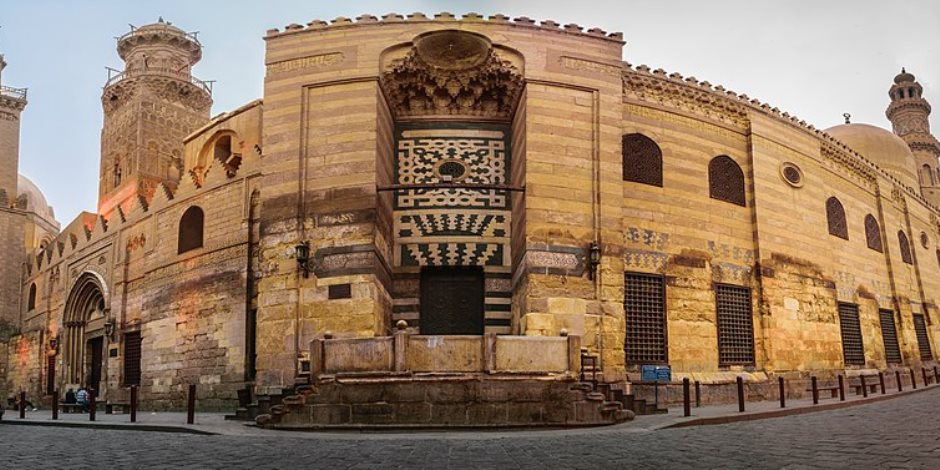
Historic Mamluk architecture along Al-Muizz Street in Islamic Cairo near the Complex of Sultan BarquqMonumental Mamluk Façade

Read the Al-Muizz Street façade

Ablaq stoneMuqarnas portal

Tall recessed window bays, black-and-white stonework, carved muqarnas and the soaring stone minaret turn the street elevation into a statement of new Burji Mamluk authority.

Historic Mamluk architecture along Al-Muizz Street in Islamic Cairo near the Complex of Sultan BarquqCentral Courtyard

Enter the four-iwan courtyard

SahnFountain pavilion

The open sahn is organized around an octagonal ablution pavilion supported by marble columns, with four grand iwans opening around the court.

Historic Mamluk architecture along Al-Muizz Street in Islamic Cairo near the Complex of Sultan BarquqQibla Sanctuary

Study the grand prayer hall

MihrabMinbarCoffered roof

The southeastern iwan contains reused granite and porphyry columns, polychrome marble, a richly decorated mihrab and one of the complex’s most impressive gilded wooden ceilings.

Historic Mamluk architecture along Al-Muizz Street in Islamic Cairo near the Complex of Sultan BarquqRoyal Mausoleum

Understand the funerary chamber

QubbaDynastic memory

Barquq built a grand mausoleum beside the qibla sanctuary, but he was ultimately buried in the Northern Cemetery. The Bayn al-Qasrayn chamber became a burial place for members of his family, including his daughter Fatima.

Historic Mamluk architecture along Al-Muizz Street in Islamic Cairo near the Complex of Sultan BarquqFour-School Madrassa

See the educational system

HanafiShafi’iMalikiHanbali

The complex supported teaching in the four canonical Sunni legal schools, with iwans, study spaces and residential cells serving a substantial student community.

Historic Mamluk architecture along Al-Muizz Street in Islamic Cairo near the Complex of Sultan BarquqSufi Khanqah

Read the institution behind the architecture

Residential lodgeEndowment

Alongside the madrassa, the khanqah housed a community of Sufis. Endowed revenues supported students, teachers, Sufis and staff with stipends, food and institutional services.

Recommended Bayn al-Qasrayn Route

How to combine Sultan Barquq with Historic Cairo

The uploaded guide places the complex at the heart of a north-to-south heritage walk through Al-Muizz Street. Keep the order flexible around opening conditions, prayer times and ticket access.

09:00–11:00

Northern Al-Muizz approach

  • Begin near Bab al-Futuh and Al-Hakim Mosque.
  • Continue south along Al-Muizz Street.
  • Pause at Al-Aqmar Mosque and Bayt al-Suhaymi.
Plan the Al-Muizz walk
11:00–13:45

Bayn al-Qasrayn core

  • Spend 1–1.5 hours inside Sultan Barquq’s complex.
  • Continue to the adjacent Qalawun complex.
  • Add the Madrassa of al-Nasir Muhammad.
Choose a guided Islamic Cairo route
13:45–17:00

Bazaar and Al-Azhar finish

  • Break for lunch near Khan el-Khalili.
  • Explore the bazaar and artisan lanes.
  • Conclude around Al-Azhar Mosque when access permits.
Open the Khan el-Khalili guide

Planning note: Opening hours, combined-ticket rules, card-payment requirements, photography permissions and footwear procedures can change. Confirm official arrangements close to the visit.

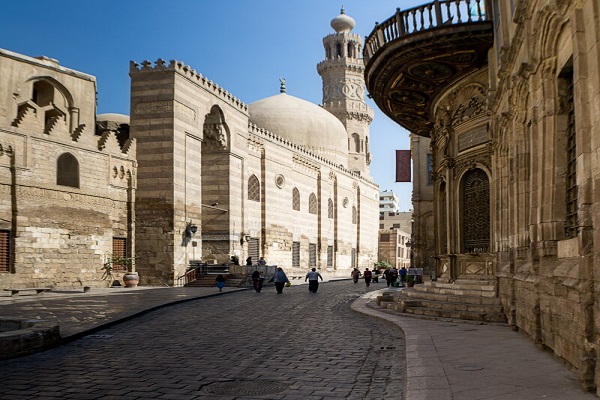
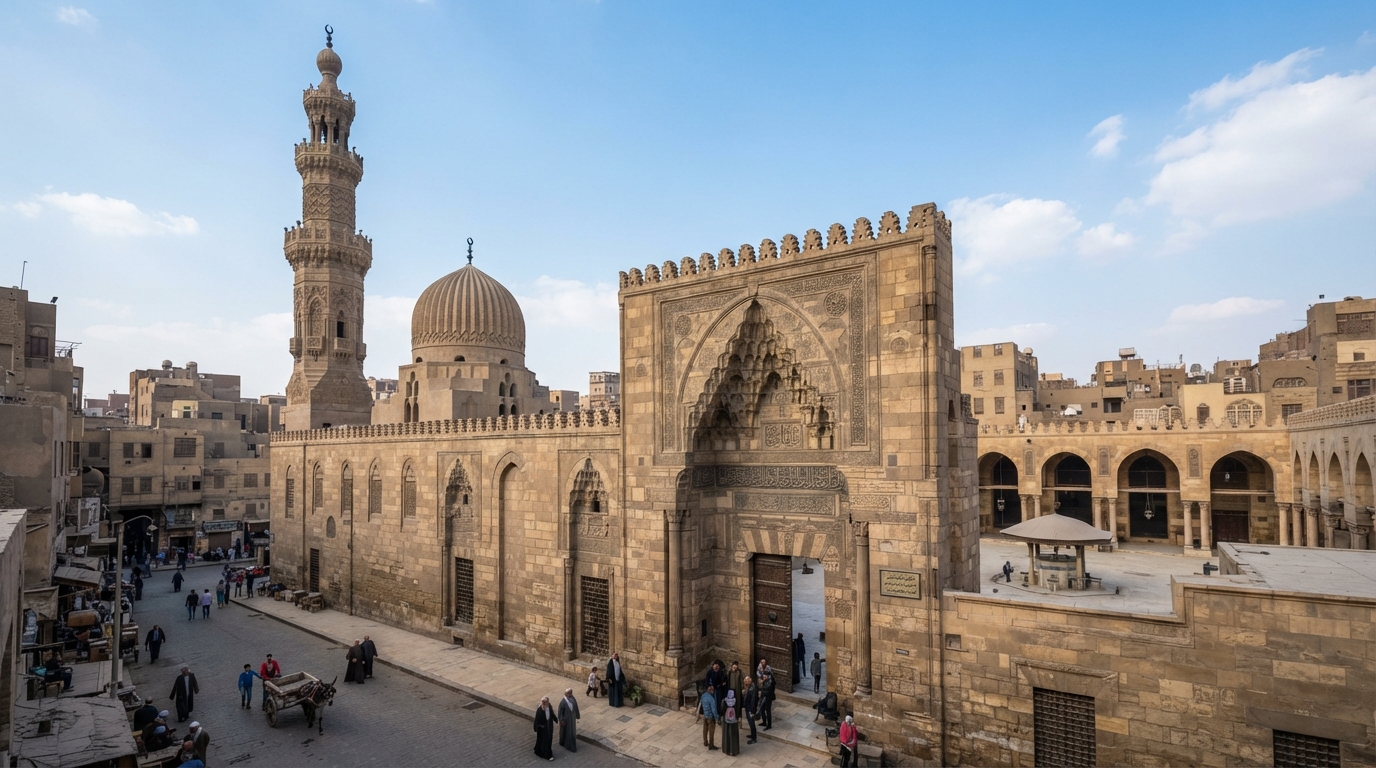
Historic Al-Muizz Street in Islamic Cairo, the setting of Sultan Barquq's complex

Trusted Heritage References

Verify Historic Cairo context with authoritative sources

Use official Egyptian heritage channels for current access and monument information, and UNESCO for the wider Historic Cairo context.

External pages open in a new tab. Visitor conditions can change, so confirm current official details before travel.

Helpful Visitor Answers

Sultan Barquq Complex questions before you go

Direct answers based on the supplied attraction guide, with practical details kept distinct from broader route planning.

Who was Sultan Al-Zahir Barquq?

Barquq was the founder of the Circassian or Burji Mamluk dynasty. He took the sultanate in 1382 and commissioned this complex soon afterward as a major religious, educational and dynastic foundation in Cairo.

Is Sultan Barquq buried in this complex?

No. Although the complex contains a royal mausoleum, Barquq was buried in Cairo’s Northern Cemetery. The Bayn al-Qasrayn mausoleum contains burials of royal family members, including his daughter Fatima.

Why is the complex architecturally important?

It combines a four-iwan madrassa, congregational mosque, Sufi khanqah and mausoleum in one urban institution and became an early monumental statement of Circassian Mamluk rule.

What should I notice in the qibla iwan?

Look for the reused granite and porphyry columns, polychrome marble, decorated mihrab, wooden minbar and the richly painted and gilded coffered ceiling.

How long should I spend at Sultan Barquq’s complex?

Allow roughly 1 to 1.5 hours for a focused visit, especially if you want time to study the courtyard, iwans, mausoleum, minaret and decorative details.

What is the connection with Khan el-Khalili?

Amir Jarkas al-Khalili, who supervised construction of Barquq’s complex, is also associated with the khan that gave Khan el-Khalili its name.

What should I wear?

Wear modest clothing covering shoulders and knees. Follow current site instructions about removing shoes or using shoe covers in prayer areas.

What should I combine with the complex?

The strongest nearby route includes the Qalawun complex, Madrassa of al-Nasir Muhammad, Al-Aqmar Mosque, Bayt al-Suhaymi, Khan el-Khalili and Al-Azhar.

Private Islamic Cairo Planning

Build a Mamluk Cairo route around Al-Muizz Street

Combine Sultan Barquq, Bayn al-Qasrayn, Al-Muizz Street, Khan el-Khalili and nearby Islamic monuments with a private guide and a route matched to your available time.