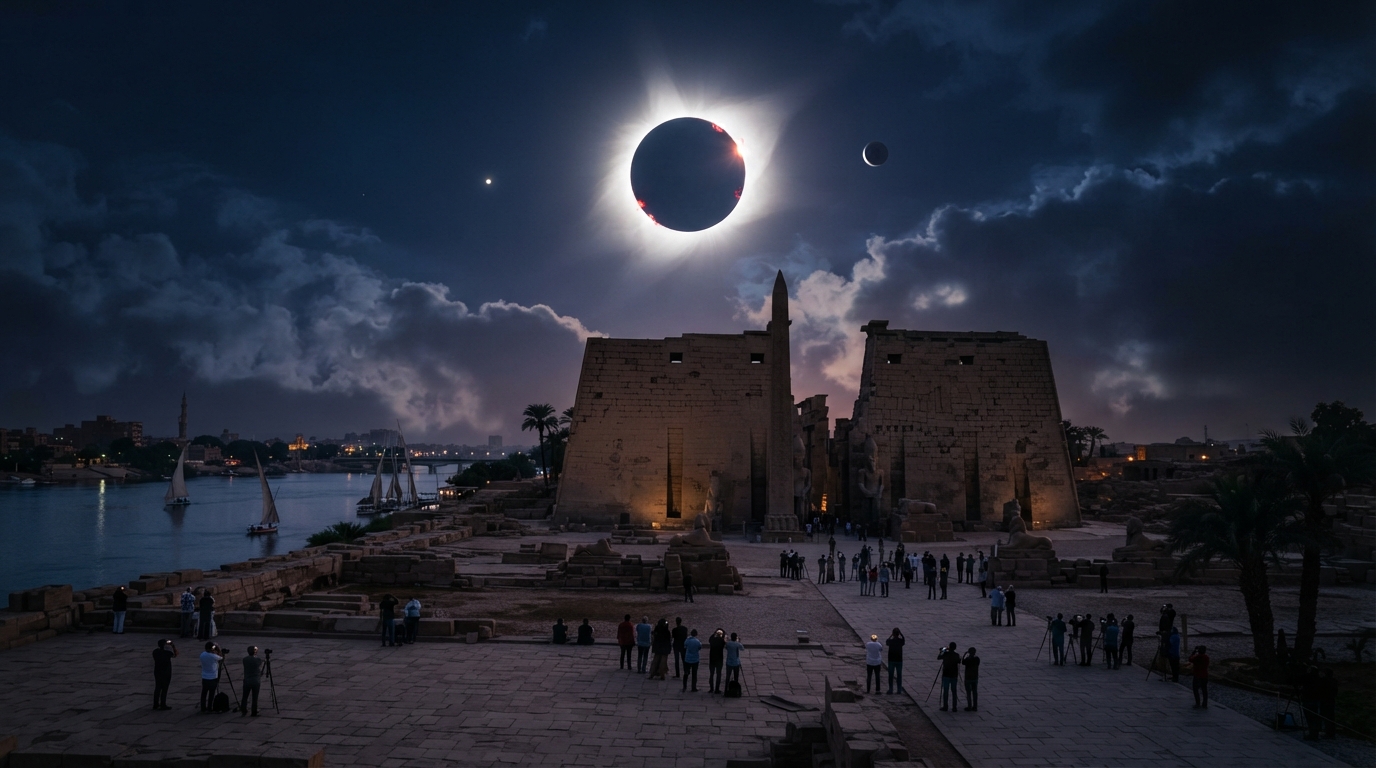
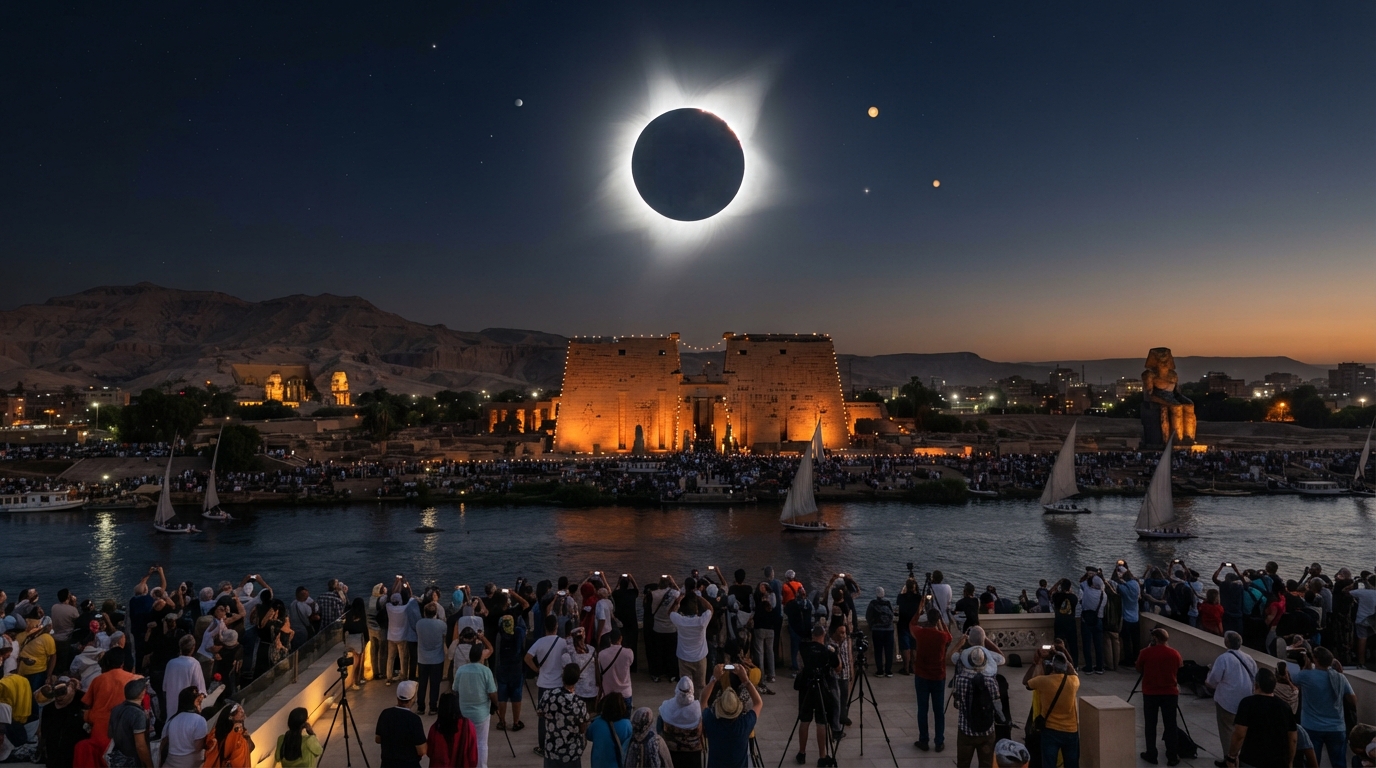
More than six minutes of totality
Luxor lies inside the central portion of the path. The long total phase gives viewers time to notice the corona, unusual light and horizon glow without rushing the experience.

On 2 August 2027, Luxor will experience about six minutes and 22 seconds of total solar eclipse. Get the local timings, safe-viewing rules, site options, heat advice and travel choices before committing to a fixed-date trip.
The total solar eclipse in Luxor takes place on Monday, 2 August 2027. The partial phase is expected to start around 11:40 AM, totality shortly after 1:02 PM, maximum eclipse around 1:05 PM and the partial phase to end around 2:26 PM, all in local Luxor time (EEST, UTC+3). Totality lasts approximately 6 minutes 22 seconds at the Luxor reference location. Final contact times depend on the exact viewing coordinates.
Check Luxor eclipse circumstances and inspect NASA's 2027 eclipse path.
The following times are city-level estimates, not a site-specific schedule. Luxor's totality begins just after 1 PM. Use the final viewing coordinates to confirm precise contacts and duration shortly before travel.
| Eclipse stage | Approximate Luxor time | What you will see | Required protection |
|---|---|---|---|
| Partial phase starts | 11:40 AM | Moon begins to move across the solar disk. | Keep compliant eclipse glasses on when looking at the Sun. |
| Totality starts | Shortly after 1:02 PM | Bright solar disk becomes completely covered. | Unaided viewing is safe only after complete totality is confirmed. |
| Maximum eclipse | About 1:05 PM | Deepest point of totality; solar corona may be visible. | Unaided viewing only during full totality. |
| Totality ends | Shortly after 1:08 PM | First direct sunlight returns. | Replace eclipse glasses immediately before looking at the Sun. |
| Partial phase ends | About 2:26 PM | Moon moves fully away from the Sun. | Use solar viewers for any direct Sun viewing until then. |
The event's appeal combines its unusually long totality with desert climate and the temples, tombs and Nile landscapes of ancient Thebes. None of those advantages eliminates the need for a clear sky and confirmed viewing access.
Luxor lies inside the central portion of the path. The long total phase gives viewers time to notice the corona, unusual light and horizon glow without rushing the experience.
Luxor's very dry summer climate is favorable for planning, but haze, dust and clouds remain possible. A forecast is not a guarantee of visibility.
Build separate sightseeing days around Karnak, Luxor Temple, the Valley of the Kings and Hatshepsut Temple, then continue to Aswan or Cairo.
Luxor's archaeological landscape is part of UNESCO-listed Ancient Thebes with its Necropolis. Those monuments are excellent cultural visits before or after the eclipse, but they are not automatically approved eclipse-viewing venues.
The best site is one with the right solar sight line, confirmed permission, reliable transfers and protection from the August heat. A striking photo location is not enough by itself.
Controlled access, shade, seating, water, toilets and designated equipment space can make a managed venue the most workable choice. The actual event-site coordinates still require written confirmation.
See the West Bank day experienceA rooftop, hotel garden or deck needs confirmed access, a clear overhead sight line, safe capacity, shading and an exact mooring or hotel position. Do not assume a cruise deck is automatically suitable.
Archaeological settings are memorable for photography, but ordinary admission does not authorize special eclipse viewing, tripod use or access outside published arrangements.
Compare Luxor viewing areasPhotos show Luxor monuments and Nile environments for destination context, not the final eclipse observation venue. No temple access, hotel platform or cruise position is guaranteed.
The key distinction is simple: direct viewing of a partially eclipsed Sun requires proper protection. Only the brief interval of complete totality may be observed with the naked eye.
Use reputable eclipse glasses or handheld viewers that conform to ISO 12312-2. Ordinary sunglasses, exposed film and improvised dark filters are not safe for direct solar viewing.
Remove eclipse glasses only after the bright face of the Sun is completely hidden and totality has begun. Replace them immediately as soon as any direct sunlight reappears.
Inspect glasses for damage and discard scratched, torn or punctured viewers. Supervise children and use indirect projection when appropriate.
Binoculars, telescopes and camera lenses need their own suitable securely mounted front-mounted solar filters during the partial phases. Wearing eclipse glasses behind unfiltered optics does not protect your eyes.
Arrive early at a venue with reliable shade, water, seats, toilets and cooling options. Sun protection and air-conditioned transport matter because the viewing period extends beyond totality.
Carry spare batteries, power banks and water-resistant storage where useful. Follow equipment-zone rules and do not block others' sightlines.
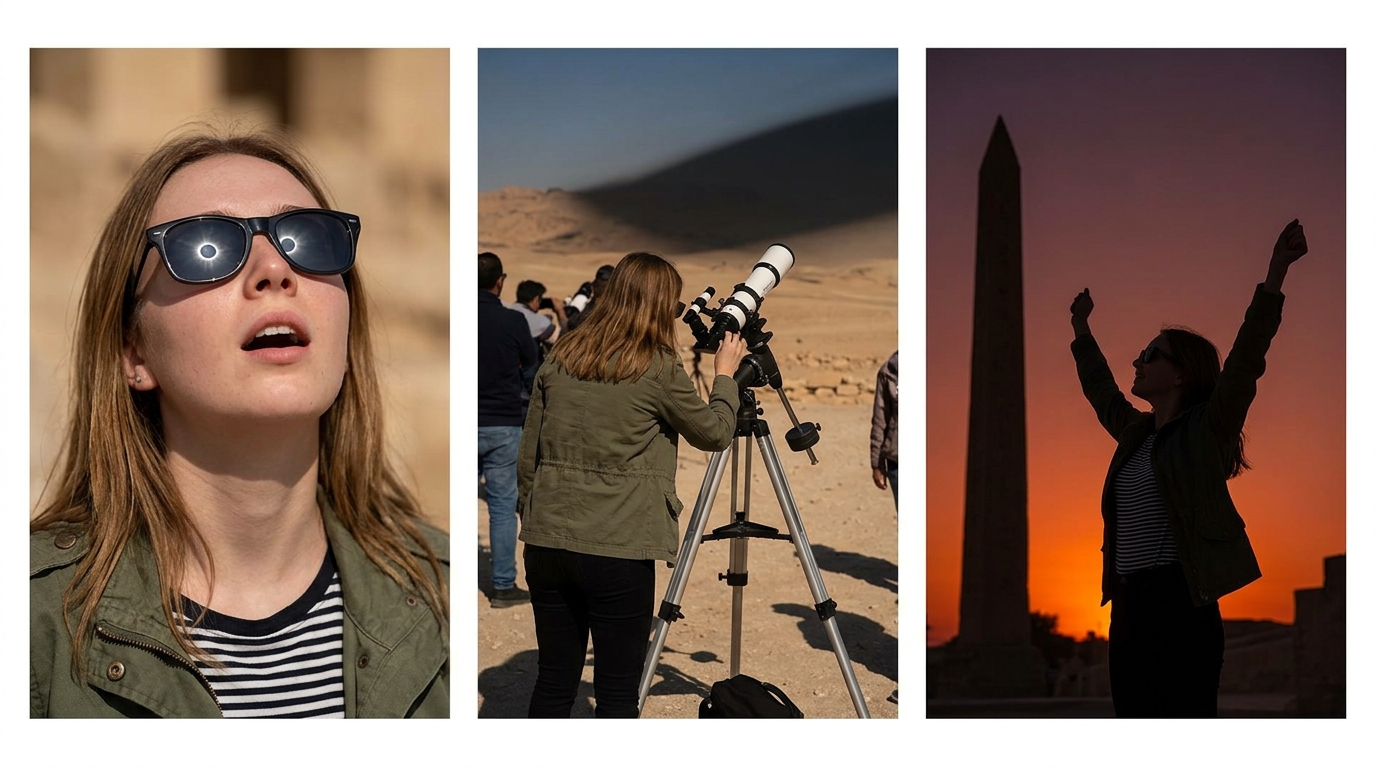
The eclipse has one fixed date. Secure where you will stay, how you will reach the observation area and what happens on the return. Arrange sightseeing around that plan, rather than risking the event window for an extra monument.
Arrive before eclipse day where possible. Confirm your hotel or vessel, bank side and pickup point. Do not rely on a same-day long-distance connection to reach the event.
Request a viewing-area description, expected reporting time, transport buffers, shade, water, toilets, safety equipment, accessibility provisions and return arrangements.
Choose your cruise direction and hotel nights around the eclipse. Allow sightseeing time for Karnak, Luxor's West Bank, Aswan and the Grand Egyptian Museum on separate days.
Where is the proposed observation area? Is it on the East or West Bank? What are the pickup and return windows? Are compliant eclipse glasses, shade, seating, toilets, water, technical support and meals included? Are private groups handled separately?
Ask for a written list covering accommodation, domestic flights or trains, cruise cabin, transfers, entrance fees, guide services, eclipse equipment and exclusions. A tour title is not an inclusion list.
Historical August sunshine is a planning advantage, not a promise. Dust, haze or cloud may still affect the view. Ask what can realistically change if forecasts worsen.
The published ETC cancellation policy states that eclipse-related payments are 100% non-refundable from written confirmation. Read the applicable terms and supplier conditions before making payment.
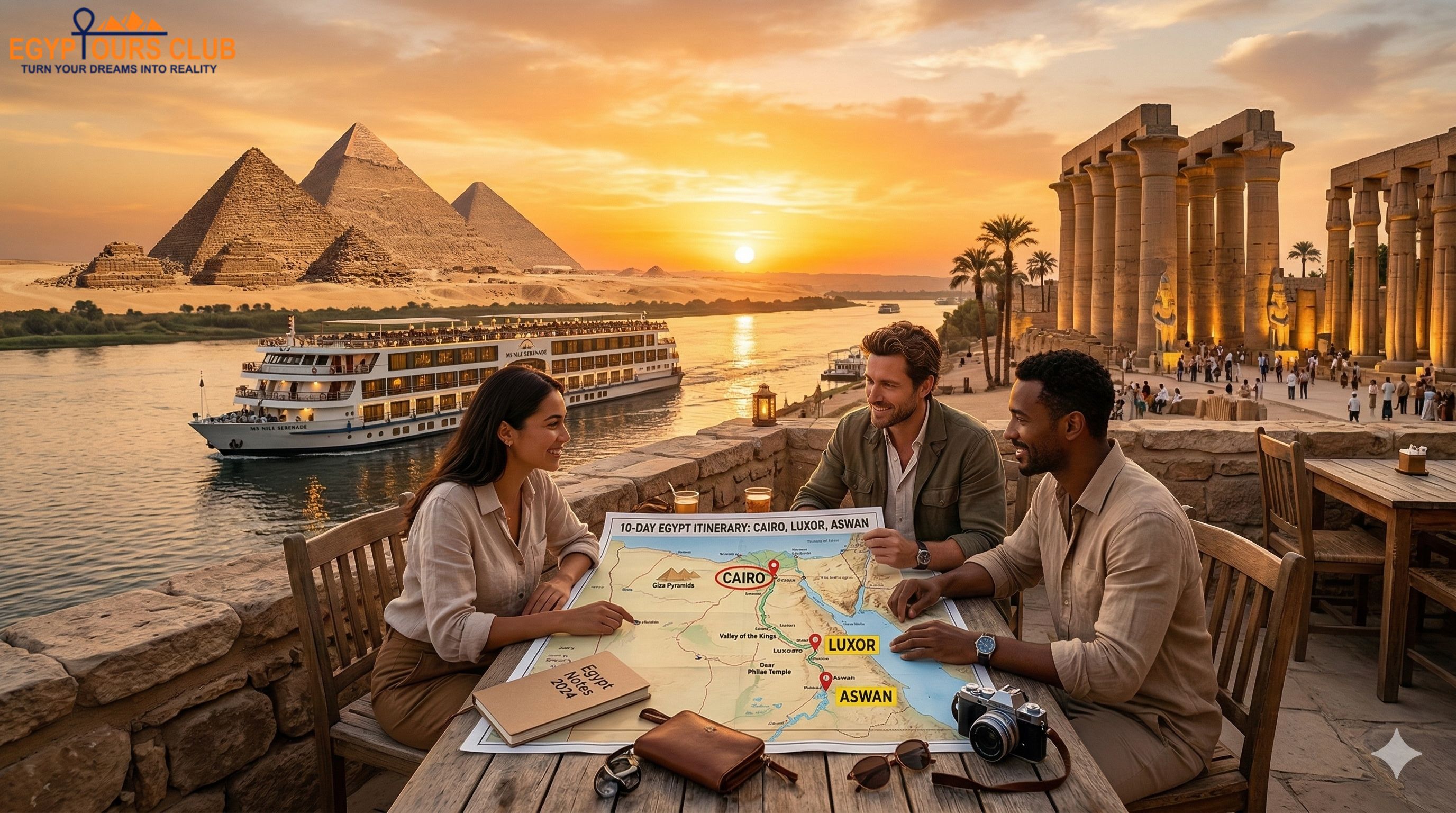
Egypt Tours Club currently publishes nine multi-day eclipse packages and a separate West Bank viewing day tour. Below are four useful starting points, followed by broader Cairo and Luxor routes. Confirm current availability and inclusions on each product page.
| Photo | Experience | Dates / duration | Good for | See details |
|---|---|---|---|---|
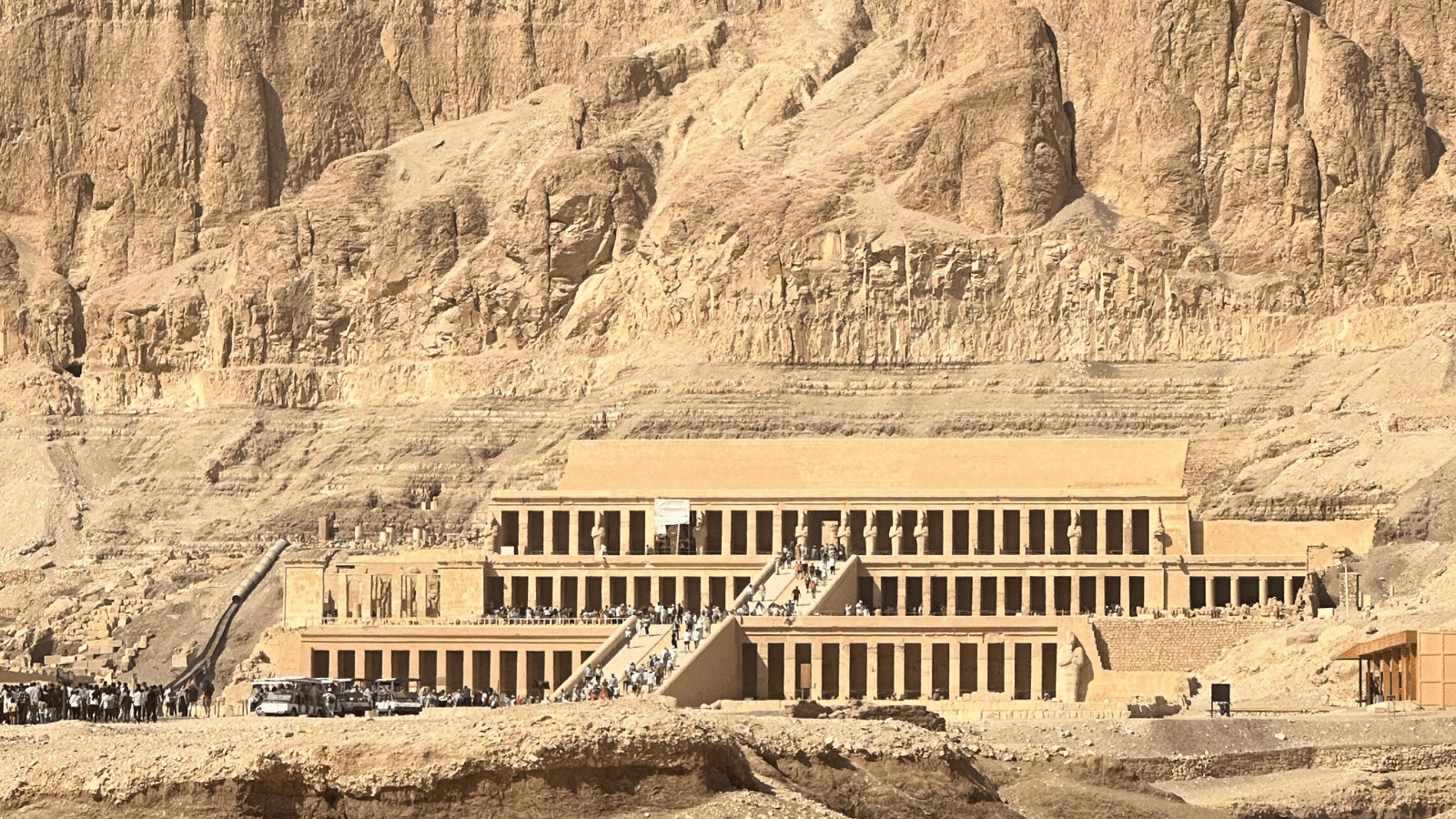 | Premium West Bank Eclipse Day Experience | 2 August 2027, day tour | Travelers who already have Luxor accommodation and need a managed event-day experience. | View day tour |
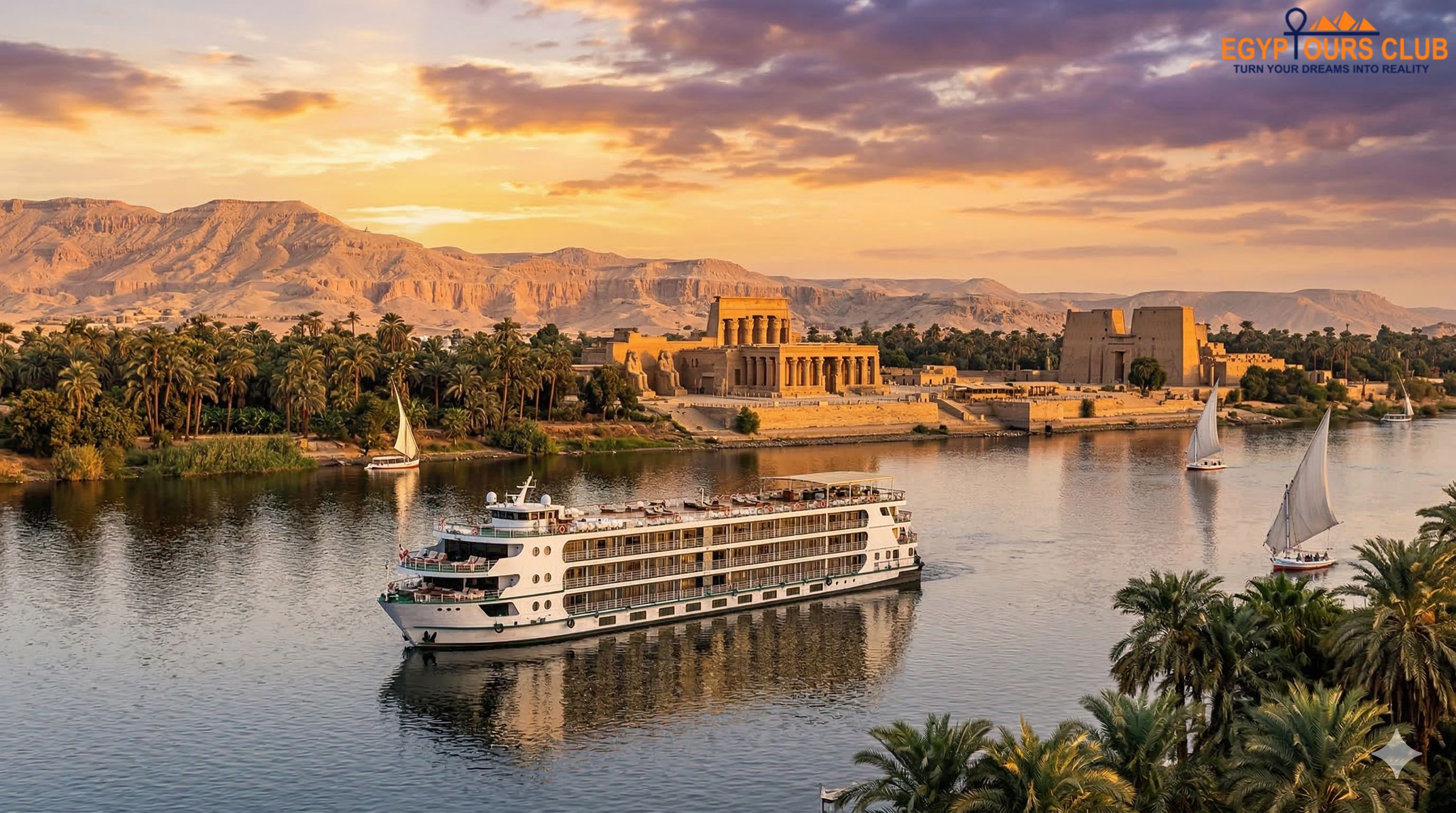 | 4-Day Aswan to Luxor Eclipse Cruise | 30 July to 2 August 2027 | Three cruise nights, northbound Nile route, with the eclipse as the final event. Luxor archaeological sightseeing is not included. | View 4-day tour |
 | 5-Day Luxor to Aswan Eclipse Cruise | 2 to 6 August 2027 | Begin in Luxor for the eclipse, then continue south to Edfu, Kom Ombo and Aswan. | View 5-day tour |
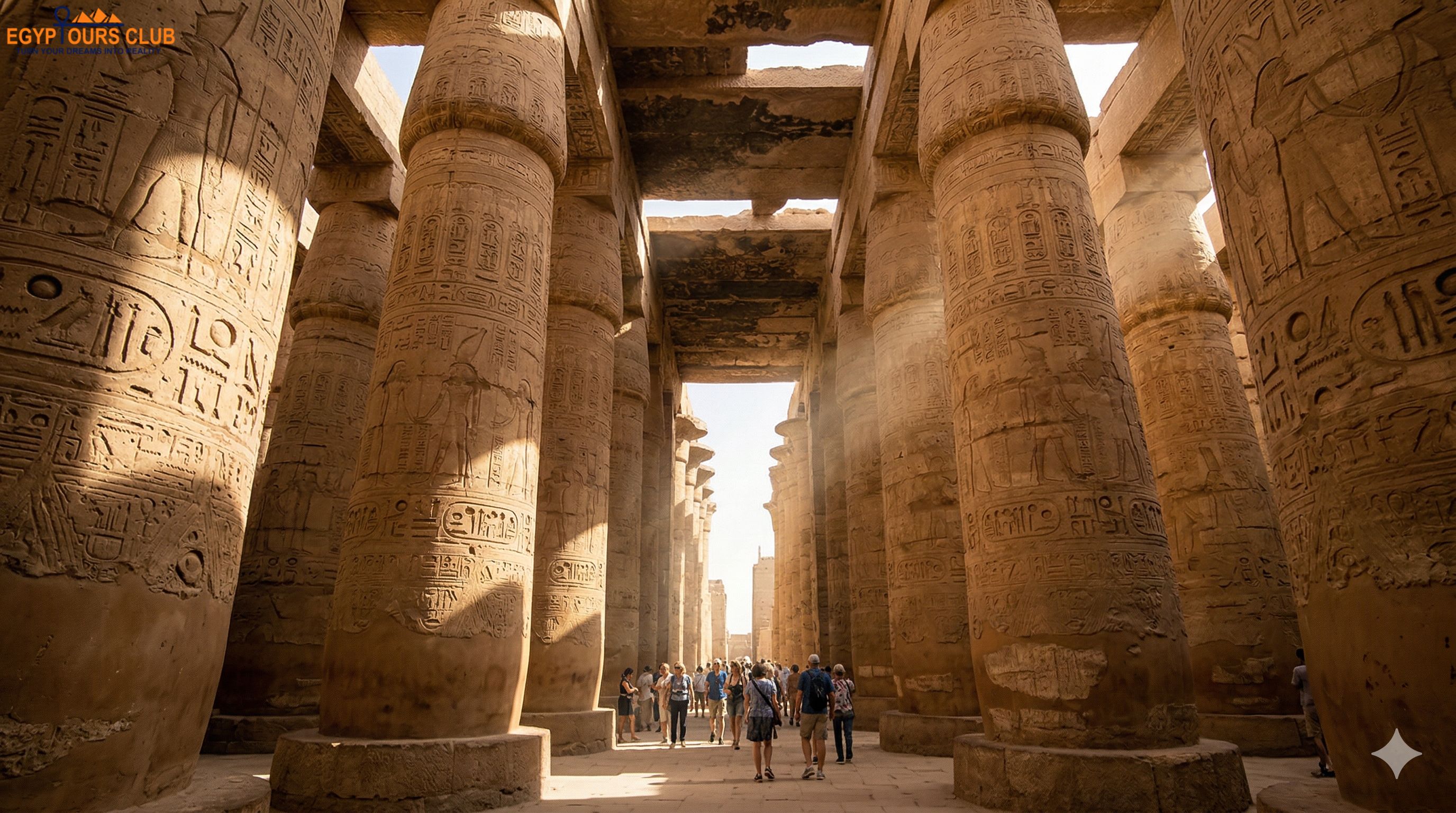 | 8-Day MS Grand Palm Eclipse Nile Cruise | 30 July to 6 August 2027 | Seven-night round-trip Nile cruise from Aswan with an eclipse day centered on Luxor. | View 8-day cruise |
A shorter journey combining the Pyramids, Grand Egyptian Museum, Luxor monuments and the eclipse. A useful choice when time is limited.
Open the 6-day routeA longer Cairo and Luxor experience with the eclipse followed by a Nile journey toward Aswan. Compare transport and cruise details before booking.
Open the 8-day routeDo not spend the entire total phase troubleshooting equipment. Practice the sequence well before travel and prepare for intense August heat.
Rehearse focusing, exposure bracketing, filter changes and tripod framing. Use specialist solar filters on optics throughout partial phases. Follow the venue's permissions and professional astronomy advice.
Carry a backup solar viewer, charged batteries, memory cards, power bank and camera protection. Check luggage restrictions for batteries and specialist equipment.
Prepare an automatic or rehearsed camera sequence if photography matters. Look away from the equipment and experience the corona, sky and landscape during the brief safe interval.
Bring a wide-brimmed hat, breathable clothing, sunscreen and sufficient water. Follow the on-site plan for shaded waiting, toilet access and rest breaks.
Families need child supervision. Large groups need named meeting points and clear departure instructions. Travelers with limited mobility should ask about vehicle access, surface conditions and walking distances.
Allow time for safety briefings, setup and the entire partial eclipse. Do not schedule an archaeological visit that could delay arrival at the observation area.
Use independent astronomy and safety references for scientific details, then confirm local access, travel services and booking terms in writing with the operator.
The eclipse date and geometry are astronomical calculations. Weather, local transport, permissions, specific hotel and cruise arrangements are travel operations. Do not present them as fixed scientific outcomes.
It takes place on Monday, 2 August 2027. Maximum eclipse in central Luxor is expected around 1:05 PM local time (EEST, UTC+3).
Approximately 6 minutes 22 seconds at the Luxor reference location, with small differences depending on the exact coordinates of the observation site.
The partial eclipse starts around 11:40 AM and finishes about 2:26 PM. Totality is expected shortly after 1:02 PM to shortly after 1:08 PM.
Only during complete totality, when the Sun's bright disk is fully covered, and only with the unaided eye. During every partial phase, use a compliant solar viewer. Cameras, binoculars and telescopes require specialist solar filters.
No. Historical August weather is favorable, but haze, dust and cloud can affect visibility. No tour company can guarantee the weather or the sight of totality.
Only if the relevant authorities approve eclipse-day access and any required viewing or photography permissions. Ordinary admission does not guarantee an eclipse venue.
Yes. Egypt Tours Club lists a separate Premium West Bank Viewing Tour for guests with their own Luxor hotel or cruise booking. Confirm the meeting point, services and final arrangements in writing.
Yes. Published packages include Aswan-to-Luxor, Luxor-to-Aswan and longer Nile routes. Check sailing dates, cabin details and the confirmed Luxor eclipse operation.
Share your arrival date, number of travelers, hotel preferences and whether you need only the eclipse day or a complete Egypt journey. Egypt Tours Club can check the current fixed-date options and prepare a written quotation with the relevant inclusions and conditions.
Editorial note: Astronomical figures use published reference calculations and may differ slightly at the confirmed viewing coordinates. Eye-safety information follows NASA and the American Astronomical Society. Weather, permits, hotels, transport, cruise schedules, prices and availability can change. All photographs and artwork on this page are hosted by Egypt Tours Club, with eclipse artwork used as illustration rather than as documentary photography of a future event. Reviewed 14 November 2026.